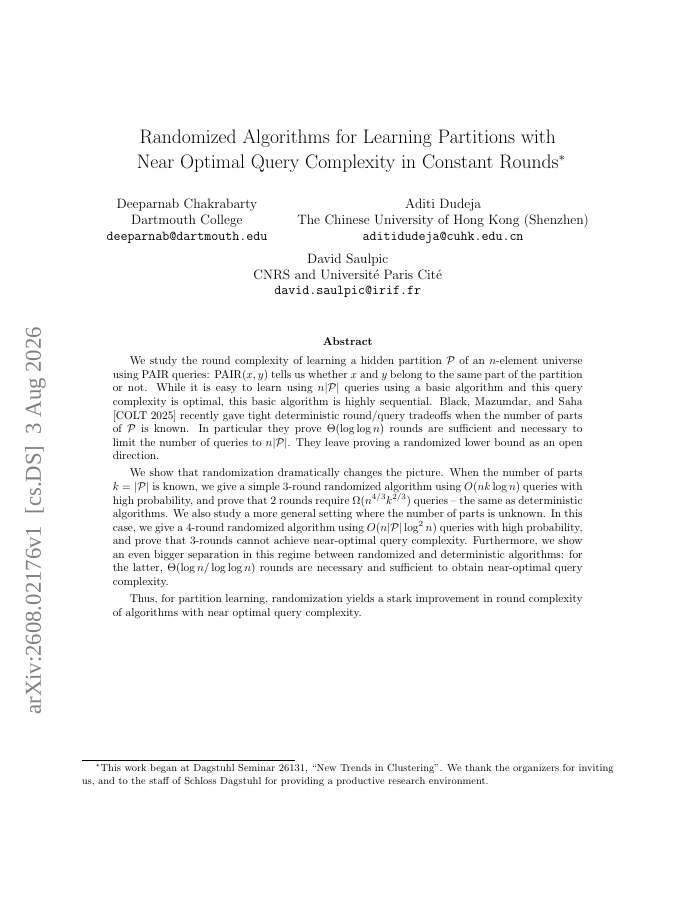
We study the round complexity of learning a hidden partition P of an n-element universe using PAIR queries: PAIR(x,y) tells us whether x and y belong to the same part of the partition or not. While it is easy to learn using n|P| queries using a basic algorithm and this query complexity is optimal, this basic algorithm is highly sequential. Black, Mazumdar, and Saha [COLT 2025] recently gave tight deterministic round/query tradeoffs when the number of parts of P is known. In particular they prove Θ(\log\log n) rounds are sufficient and necessary to limit the number of queries to n|P|. They leave proving a randomized lower bound as an open direction. We show that randomization dramatically changes the picture. When the number of parts k = |P| is known, we give a simple 3-round randomized algorithm using O(nk\log n) queries with high probability, and prove that 2 rounds require Ω(n^{4/3}k^{2/3}) queries -- the same as deterministic algorithms. We also study a more general setting where the number of parts is unknown. In this case, we give a 4-round randomized algorithm using O(n|\mathcal P|\log^2 n) queries with high probability, and prove that 3-rounds cannot achieve near-optimal query complexity. Furthermore, we show an even bigger separation in this regime between randomized and deterministic algorithms: for the latter, Θ(\log n/\log\log n) rounds are necessary and sufficient to obtain near-optimal query complexity.
Randomized Algorithms for Learning Partitions with Near Optimal Query Complexity in Constant Rounds
We study the round complexity of learning a hidden partition $\mathcal{P}$ of an $n$-element universe using PAIR queries: PAIR($x,y$) tells us whether $x$ and $y$ belong to the same part of the partition or not.
- Preview
- Year
- 2026
- Hosting
- Abstract onlyARXIV-DEFAULT
Cite
Notes
Only stored in your browser.
Attribution
- Abstract & full text
- arxiv.org/abs/2608.02176ARXIV-DEFAULT
- TL;DR
- Semantic Scholar