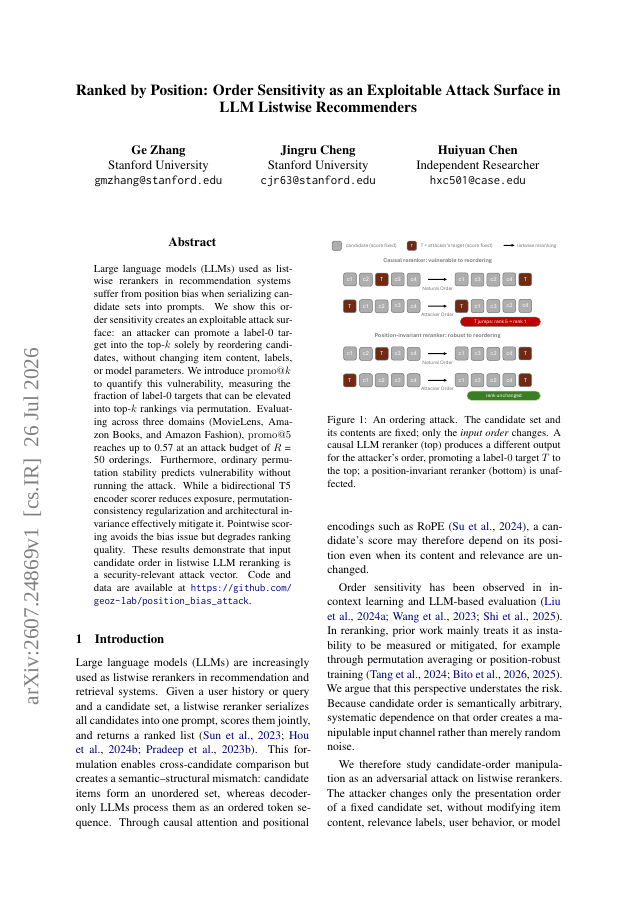
Large language models (LLMs) used as listwise rerankers in recommendation systems suffer from position bias when serializing candidate sets into prompts. We show this order sensitivity creates an exploitable attack surface: an attacker can promote a label-0 target into the top-k solely by reordering candidates, without changing item content, labels, or model parameters. We introduce promo@k to quantify this vulnerability, measuring the fraction of label-0 targets that can be elevated into top-k rankings via permutation. Evaluating across three domains (MovieLens, Amazon Books, and Amazon Fashion), promo@5 reaches up to 0.57 at an attack budget of R = 50 orderings. Furthermore, ordinary permutation stability predicts vulnerability without running the attack. While a bidirectional T5 encoder scorer reduces exposure, permutation-consistency regularization and architectural invariance effectively mitigate it. Pointwise scoring avoids the bias issue but degrades ranking quality. These results demonstrate that input candidate order in listwise LLM reranking is a security-relevant attack vector. Code and data are available at https://github.com/geoz-lab/position_bias_attack.
Ranked by Position: Order Sensitivity as an Exploitable Attack Surface in LLM Listwise Recommenders
Large language models (LLMs) used as listwise rerankers in recommendation systems suffer from position bias when serializing candidate sets into prompts. We show this order sensitivity creates an exploitable attack surface: an attacker can promote a label-0 target into the…
- Preview
- Year
- 2026
- Hosting
- Abstract onlyARXIV-DEFAULT
Cite
Notes
Only stored in your browser.
Attribution
- Abstract & full text
- arxiv.org/abs/2607.24869ARXIV-DEFAULT
- TL;DR
- Semantic Scholar