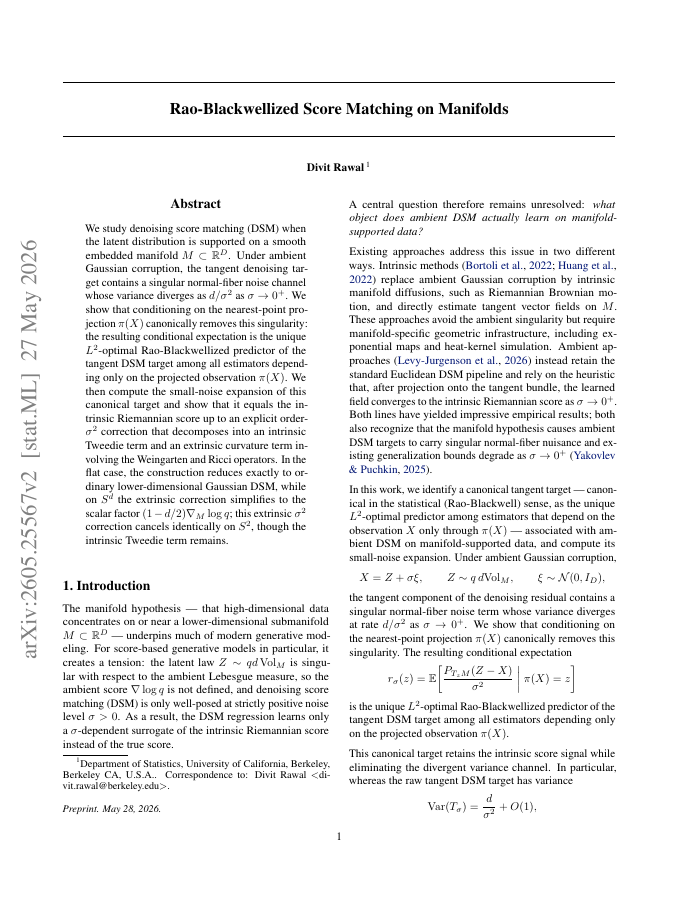
We study denoising score matching (DSM) when the latent distribution is supported on a smooth embedded manifold M \subset \mathbb{R}^D. Under ambient Gaussian corruption, the tangent denoising target contains a singular normal-fiber noise channel whose variance diverges as d/σ^2 as σ\to 0^+. We show that conditioning on the nearest-point projection π(X) canonically removes this singularity: the resulting conditional expectation is the unique L^2-optimal Rao-Blackwellized predictor of the tangent DSM target among all estimators depending only on the projected observation π(X). We then compute the small-noise expansion of this canonical target and show that it equals the intrinsic Riemannian score up to an explicit order-σ^2 correction that decomposes into an intrinsic Tweedie term and an extrinsic curvature term involving the Weingarten and Ricci operators. In the flat case, the construction reduces exactly to ordinary lower-dimensional Gaussian DSM, while on S^d the extrinsic correction simplifies to the scalar factor (1-d/2)\nabla_M \log q; this extrinsic σ^2 correction cancels identically on S^2, though the intrinsic Tweedie term remains.
Rao-Blackwellized Score Matching on Manifolds
We study denoising score matching (DSM) when the latent distribution is supported on a smooth embedded manifold $M \subset \mathbb{R}^D$. Under ambient Gaussian corruption, the tangent denoising target contains a singular normal-fiber noise channel whose variance diverges as…
- Preview
- Year
- 2026
- Hosting
- Abstract onlyARXIV-DEFAULT
Cite
Notes
Only stored in your browser.
Attribution
- Abstract & full text
- arxiv.org/abs/2605.25567ARXIV-DEFAULT
- TL;DR
- Semantic Scholar