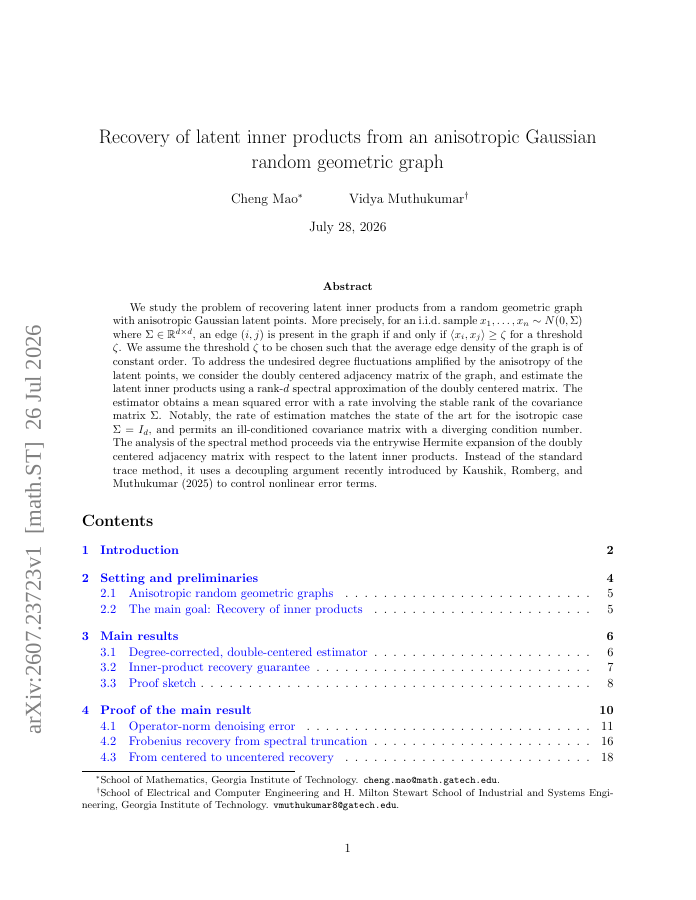
We study the problem of recovering latent inner products from a random geometric graph with anisotropic Gaussian latent points. More precisely, for an i.i.d. sample x_1, \dots, x_n \sim N(0,Σ) where Σ\in \mathbb{R}^{d \times d}, an edge (i,j) is present in the graph if and only if \langle x_i, x_j \rangle \ge ζ for a threshold ζ. We assume the threshold ζ to be chosen such that the average edge density of the graph is of constant order. To address the undesired degree fluctuations amplified by the anisotropy of the latent points, we consider the doubly centered adjacency matrix of the graph, and estimate the latent inner products using a rank-d spectral approximation of the doubly centered matrix. The estimator obtains a mean squared error with a rate involving the stable rank of the covariance matrix Σ. Notably, the rate of estimation matches the state of the art for the isotropic case Σ= I_d, and permits an ill-conditioned covariance matrix with a diverging condition number. The analysis of the spectral method proceeds via the entrywise Hermite expansion of the doubly centered adjacency matrix with respect to the latent inner products. Instead of the standard trace method, it uses a decoupling argument recently introduced by Kaushik, Romberg, and Muthukumar (2025) to control nonlinear error terms.
Recovery of latent inner products from an anisotropic Gaussian random geometric graph
We study the problem of recovering latent inner products from a random geometric graph with anisotropic Gaussian latent points. More precisely, for an i.i.d. sample $x_1, \dots, x_n \sim N(0,Σ)$ where $Σ\in \mathbb{R}^{d \times d}$, an edge $(i,j)$ is present in the graph if and…
- Preview
- Year
- 2026
- Hosting
- Abstract onlyARXIV-DEFAULT
Cite
Notes
Only stored in your browser.
Attribution
- Abstract & full text
- arxiv.org/abs/2607.23723ARXIV-DEFAULT
- TL;DR
- Semantic Scholar