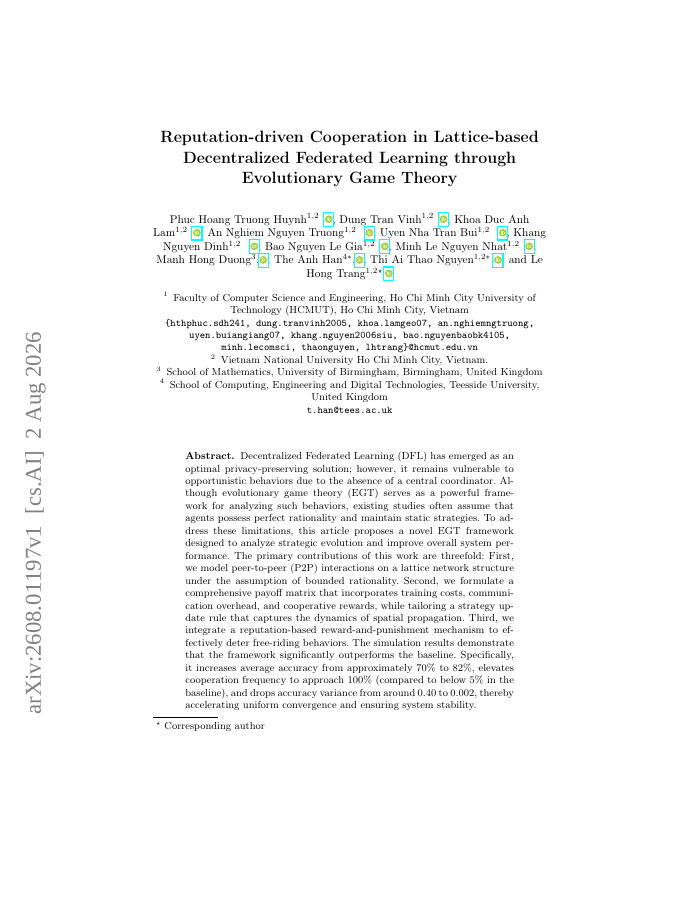
Decentralized Federated Learning (DFL) has emerged as an optimal privacy-preserving solution; however, it remains vulnerable to opportunistic behaviors due to the absence of a central coordinator. While Evolutionary Game Theory (EGT) serves as a powerful framework for analyzing such behaviors, existing studies often assume that agents possess perfect rationality and maintain static strategies. To address these limitations, this paper proposes a novel EGT framework designed to analyze strategic evolution and enhance overall system performance. The primary contributions of this work are threefold: First, we model peer-to-peer (P2P) interactions on a lattice network structure under the assumption of bounded rationality. Second, we formulate a comprehensive payoff matrix incorporating training costs, communication overhead, and cooperative rewards, while tailoring a strategy update rule that captures spatial propagation dynamics. Third, we integrate a reputation-based reward-and-punishment mechanism to effectively deter free-riding behaviors. Simulation results demonstrate that the framework significantly outperforms the baseline. Specifically, it increases average accuracy from approximately 70% to 82%, elevates cooperation frequency to approach 100% (compared to below 5% in the baseline), and drops accuracy variance from around 0.40 to 0.002, thereby accelerating uniform convergence and ensuring system stability.
Reputation-driven Cooperation in Lattice-based Decentralized Federated Learning through Evolutionary Game Theory
Decentralized Federated Learning (DFL) has emerged as an optimal privacy-preserving solution; however, it remains vulnerable to opportunistic behaviors due to the absence of a central coordinator.
- Preview
- Year
- 2026
- Hosting
- Full text hostedCC-BY-4.0
Cite
Notes
Only stored in your browser.
Attribution
- Abstract & full text
- arxiv.org/abs/2608.01197CC-BY-4.0
- TL;DR
- Semantic Scholar