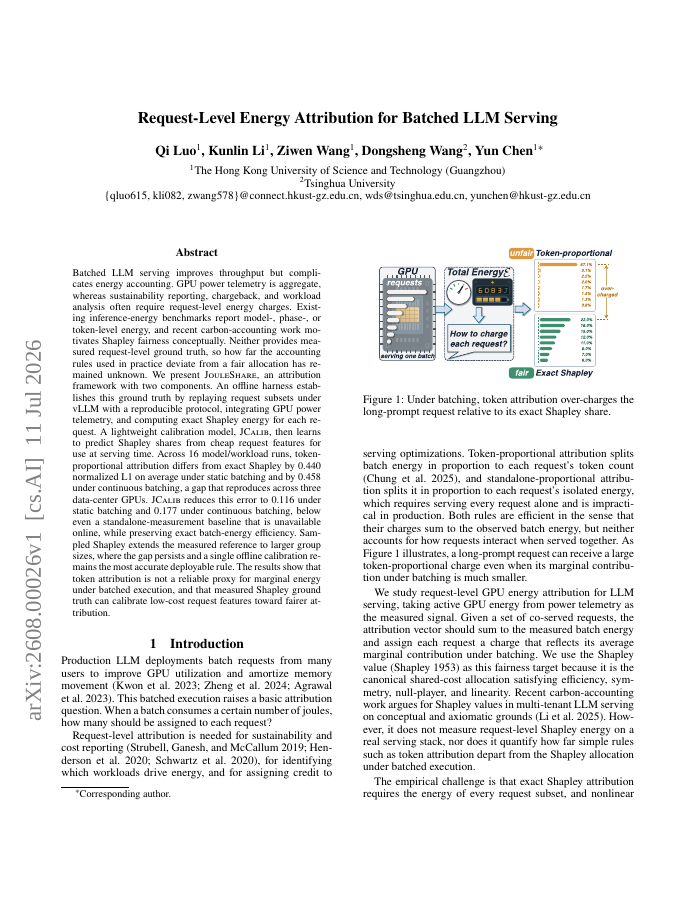
Batched LLM serving improves throughput but complicates energy accounting. GPU power telemetry is aggregate, whereas sustainability reporting, chargeback, and workload analysis often require request-level energy charges. Existing inference-energy benchmarks report model-, phase-, or token-level energy, and recent carbon-accounting work motivates Shapley fairness conceptually. Neither provides measured request-level ground truth, so how far the accounting rules used in practice deviate from a fair allocation has remained unknown. We present JouleShare, an attribution framework with two components. An offline harness establishes this ground truth by replaying request subsets under vLLM with a reproducible protocol, integrating GPU power telemetry, and computing exact Shapley energy for each request. A lightweight calibration model, JCalib, then learns to predict Shapley shares from cheap request features for use at serving time. Across 16 model/workload runs, token-proportional attribution differs from exact Shapley by 0.440 normalized L1 on average under static batching and by 0.458 under continuous batching, a gap that reproduces across three data-center GPUs. JCalib reduces this error to 0.116 under static batching and 0.177 under continuous batching, below even a standalone-measurement baseline that is unavailable online, while preserving exact batch-energy efficiency. Sampled Shapley extends the measured reference to larger group sizes, where the gap persists and a single offline calibration remains the most accurate deployable rule. The results show that token attribution is not a reliable proxy for marginal energy under batched execution, and that measured Shapley ground truth can calibrate low-cost request features toward fairer attribution.
Request-Level Energy Attribution for Batched LLM Serving
Batched LLM serving improves throughput but complicates energy accounting. GPU power telemetry is aggregate, whereas sustainability reporting, chargeback, and workload analysis often require request-level energy charges.
- Preview
- Year
- 2026
- Hosting
- Abstract onlyARXIV-DEFAULT
Cite
Notes
Only stored in your browser.
Attribution
- Abstract & full text
- arxiv.org/abs/2608.00026ARXIV-DEFAULT
- TL;DR
- Semantic Scholar