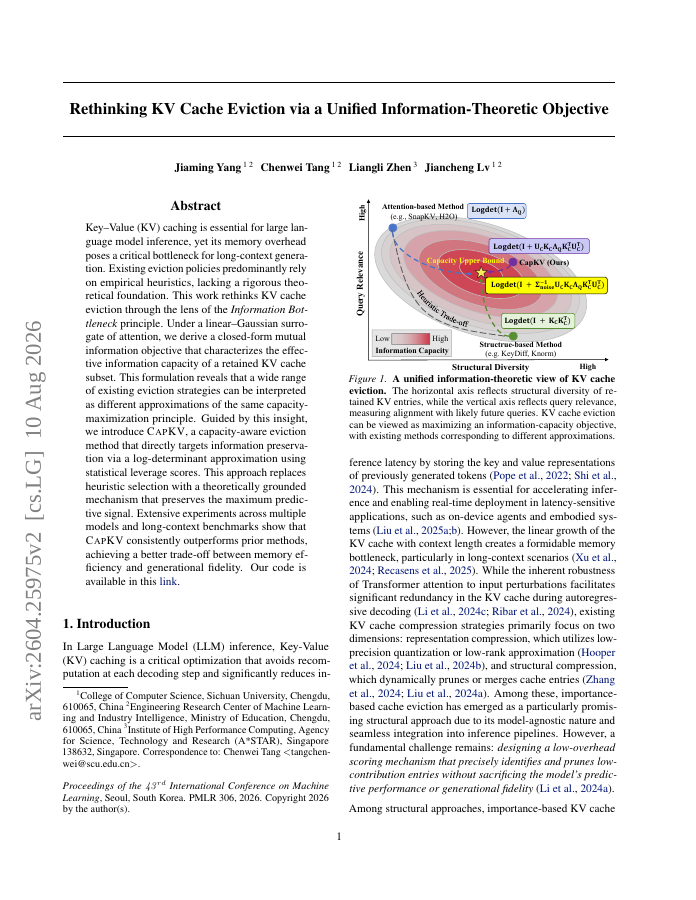
Key-Value (KV) caching is essential for large language model inference, yet its memory overhead poses a critical bottleneck for long-context generation. Existing eviction policies predominantly rely on empirical heuristics, lacking a rigorous theoretical foundation. This work rethinks KV cache eviction through the lens of the Information Bottleneck principle. Under a linear-Gaussian surrogate of attention, we derive a closed-form mutual information objective that characterizes the effective information capacity of a retained KV cache subset. This formulation reveals that a wide range of existing eviction strategies can be interpreted as different approximations of the same capacity-maximization principle. Guided by this insight, we introduce CapKV, a capacity-aware eviction method that directly targets information preservation via a log-determinant approximation using statistical leverage scores. This approach replaces heuristic selection with a theoretically grounded mechanism that preserves the maximum predictive signal. Extensive experiments across multiple models and long-context benchmarks show that CapKV consistently outperforms prior methods, achieving a better trade-off between memory efficiency and generational fidelity. Our code is available at https://github.com/jiamingyy/CapKV
Rethinking KV Cache Eviction via a Unified Information-Theoretic Objective
Key-Value (KV) caching is essential for large language model inference, yet its memory overhead poses a critical bottleneck for long-context generation. Existing eviction policies predominantly rely on empirical heuristics, lacking a rigorous theoretical foundation.
- Preview
- Year
- 2026
- Hosting
- Abstract onlyARXIV-DEFAULT
Cite
Notes
Only stored in your browser.
Attribution
- Abstract & full text
- arxiv.org/abs/2604.25975ARXIV-DEFAULT
- TL;DR
- Semantic Scholar