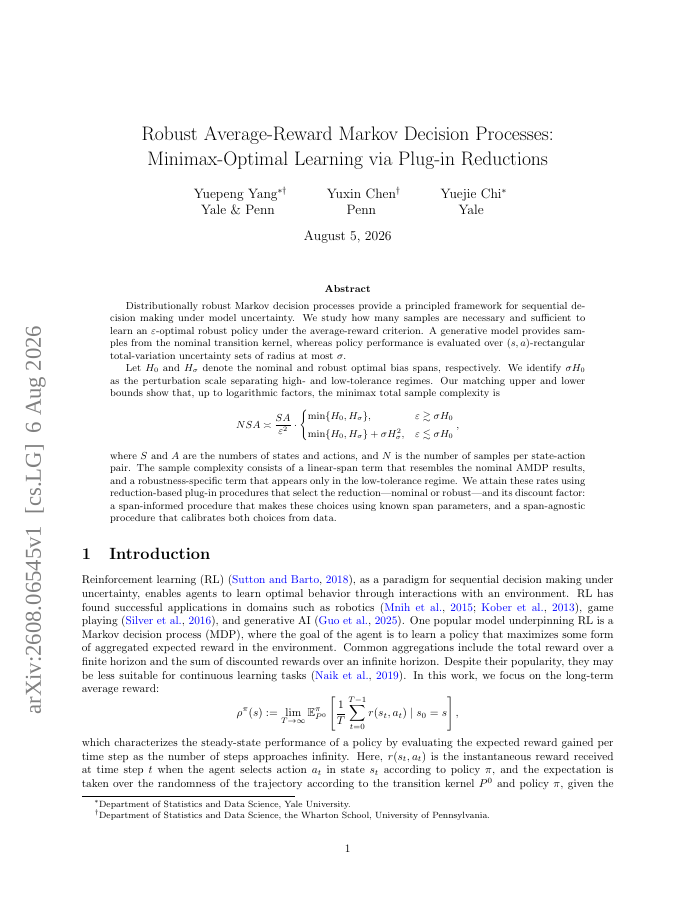
Distributionally robust Markov decision processes provide a principled framework for sequential decision making under model uncertainty. We study how many samples are necessary and sufficient to learn an \varepsilon-optimal robust policy under the average-reward criterion. A generative model provides samples from the nominal transition kernel, whereas policy performance is evaluated over (s,a)-rectangular total-variation uncertainty sets of radius at most σ. Let H_0 and H_σ denote the nominal and robust optimal bias spans, respectively. We identify σH_0 as the perturbation scale separating high- and low-tolerance regimes. Our matching upper and lower bounds show that, up to logarithmic factors, the minimax total sample complexity is $ NSA \asymp \frac{SA}{\varepsilon^2}\begin{cases} \min{H_0,H_σ}, & \varepsilon\gtrsimσH_0,\ \min{H_0,H_σ}+σH_σ^2, & \varepsilon\lesssimσH_0. \end{cases} Here S and A are the numbers of states and actions, and N$ is the number of samples per state-action pair. The sample complexity consists of a linear-span term that resembles the nominal AMDP results and a robustness-specific term that appears only in the low-tolerance regime. We attain these rates using reduction-based plug-in procedures that select the reduction---nominal or robust---and its discount factor: a span-informed procedure that makes these choices using known span parameters, and a span-agnostic procedure that calibrates both choices from data.
Robust Average-Reward Markov Decision Processes: Minimax-Optimal Learning via Plug-in Reductions
Distributionally robust Markov decision processes provide a principled framework for sequential decision making under model uncertainty. We study how many samples are necessary and sufficient to learn an $\varepsilon$-optimal robust policy under the average-reward criterion.
- Preview
- Year
- 2026
- Hosting
- Full text hostedCC-BY-4.0
Cite
Notes
Only stored in your browser.
Attribution
- Abstract & full text
- arxiv.org/abs/2608.06545CC-BY-4.0
- TL;DR
- Semantic Scholar