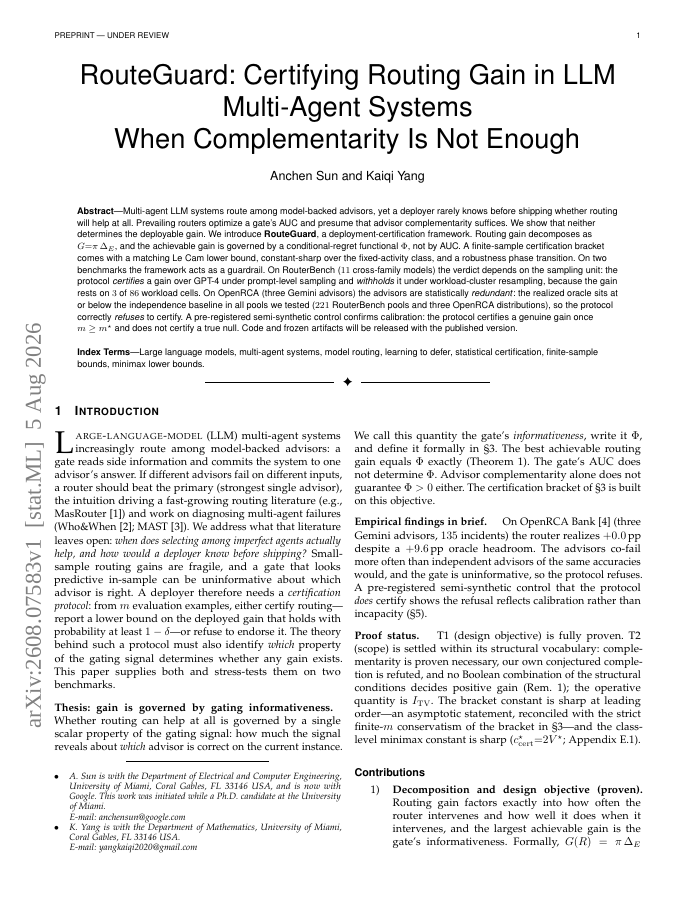
Multi-agent LLM systems route among model-backed advisors, yet a deployer rarely knows before shipping whether routing will help at all. Prevailing routers optimize a gate's AUC and presume that advisor complementarity suffices. We show that neither determines the deployable gain. We introduce RouteGuard, a deployment-certification framework. Routing gain decomposes as G = πΔ_E, and the achievable gain is governed by a conditional-regret functional Φ, not by AUC. A finite-sample certification bracket comes with a matching Le Cam lower bound, constant-sharp over the fixed-activity class, and a robustness phase transition. On two benchmarks the framework acts as a guardrail. On RouterBench (11 cross-family models) the verdict depends on the sampling unit: the protocol certifies a gain over GPT-4 under prompt-level sampling and withholds it under workload-cluster resampling, because the gain rests on 3 of 86 workload cells. On OpenRCA (three Gemini advisors) the advisors are statistically redundant: the realized oracle sits at or below the independence baseline in all pools we tested (221 RouterBench pools and three OpenRCA distributions), so the protocol correctly refuses to certify. A pre-registered semi-synthetic control confirms calibration: the protocol certifies a genuine gain once m \ge m^\star and does not certify a true null. Code and frozen artifacts will be released with the published version.
RouteGuard: Certifying Routing Gain in LLM Multi-Agent Systems When Complementarity Is Not Enough
Multi-agent LLM systems route among model-backed advisors, yet a deployer rarely knows before shipping whether routing will help at all. Prevailing routers optimize a gate's AUC and presume that advisor complementarity suffices.
- Preview
- Year
- 2026
- Hosting
- Excerpt onlyCC-BY-NC-4.0
Cite
Notes
Only stored in your browser.
Attribution
- Abstract & full text
- arxiv.org/abs/2608.07583CC-BY-NC-4.0
- TL;DR
- Semantic Scholar