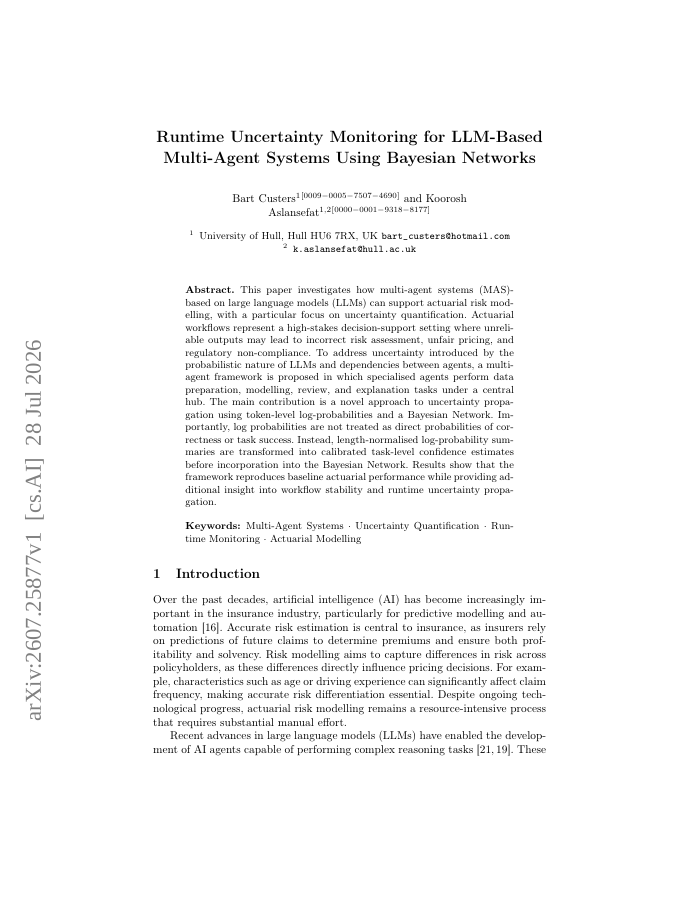
This paper investigates how multi-agent systems (MAS)-based on large language models (LLMs) can support actuarial risk modelling, with a particular focus on uncertainty quantification. Actuarial workflows represent a high-stakes decision-support setting where unreliable outputs may lead to incorrect risk assessment, unfair pricing, and regulatory non-compliance. To address uncertainty introduced by the probabilistic nature of LLMs and dependencies between agents, a multi-agent framework is proposed in which specialised agents perform data preparation, modelling, review, and explanation tasks under a central hub. The main contribution is a novel approach to uncertainty propagation using token-level log-probabilities and a Bayesian Network. Importantly, log probabilities are not treated as direct probabilities of correctness or task success. Instead, length-normalised log-probability summaries are transformed into calibrated task-level confidence estimates before incorporation into the Bayesian Network. Results show that the framework reproduces baseline actuarial performance while providing additional insight into workflow stability and runtime uncertainty propagation.
Runtime Uncertainty Monitoring for LLM-Based Multi-Agent Systems Using Bayesian Networks
This paper investigates how multi-agent systems (MAS)-based on large language models (LLMs) can support actuarial risk modelling, with a particular focus on uncertainty quantification.
- Preview
- Year
- 2026
- Hosting
- Full text hostedCC-BY-4.0
Cite
Notes
Only stored in your browser.
Attribution
- Abstract & full text
- arxiv.org/abs/2607.25877CC-BY-4.0
- TL;DR
- Semantic Scholar