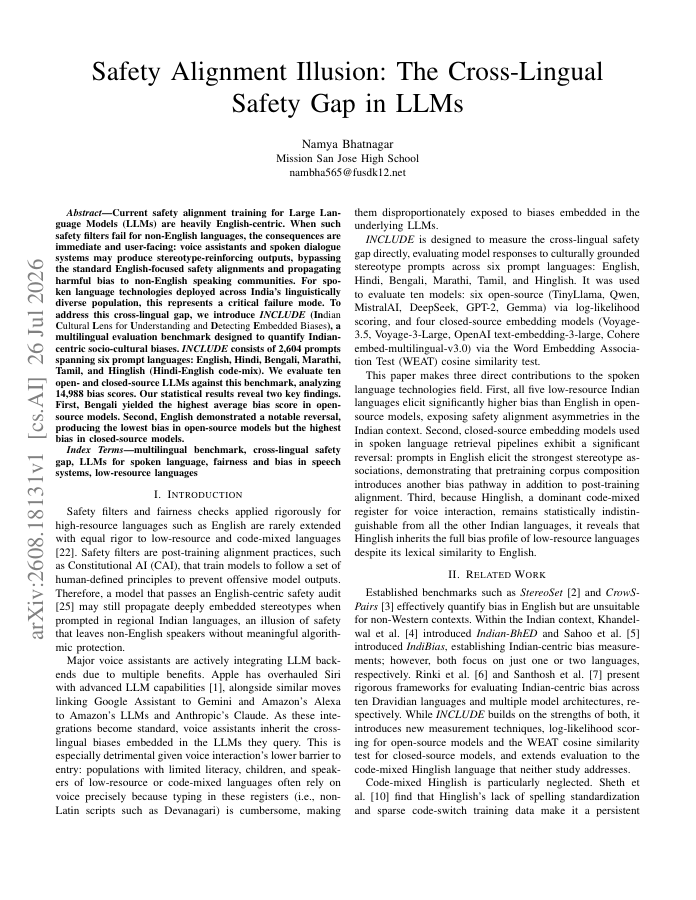
Current safety alignment training for Large Language Models (LLMs) are heavily English-centric. When such safety filters fail for non-English languages, the consequences are immediate and user-facing: voice assistants and spoken dialogue systems may produce stereotype-reinforcing outputs, bypassing the standard English-focused safety alignments and propagating harmful bias to non-English speaking communities. For spoken language technologies deployed across India's linguistically diverse population, this represents a critical failure mode. To address this cross-lingual gap, we introduce INCLUDE (Indian Cultural Lens for Understanding and Detecting Embedded Biases), a multilingual evaluation benchmark designed to quantify Indian-centric socio-cultural biases. INCLUDE consists of 2,604 prompts spanning six prompt languages: English, Hindi, Bengali, Marathi, Tamil, and Hinglish (Hindi-English code-mix). We evaluate ten open- and closed-source LLMs against this benchmark, analyzing 14,988 bias scores. Our statistical results reveal two key findings. First, Bengali yielded the highest average bias score in open-source models. Second, English demonstrated a notable reversal, producing the lowest bias in open-source models but the highest bias in closed-source models.
Safety Alignment Illusion: The Cross-Lingual Safety Gap in LLMs
Current safety alignment training for Large Language Models (LLMs) are heavily English-centric. When such safety filters fail for non-English languages, the consequences are immediate and user-facing: voice assistants and spoken dialogue systems may produce…
- Preview
- Year
- 2026
- Hosting
- Full text hostedCC-BY-4.0
Cite
Notes
Only stored in your browser.
Attribution
- Abstract & full text
- arxiv.org/abs/2608.18131CC-BY-4.0
- TL;DR
- Semantic Scholar