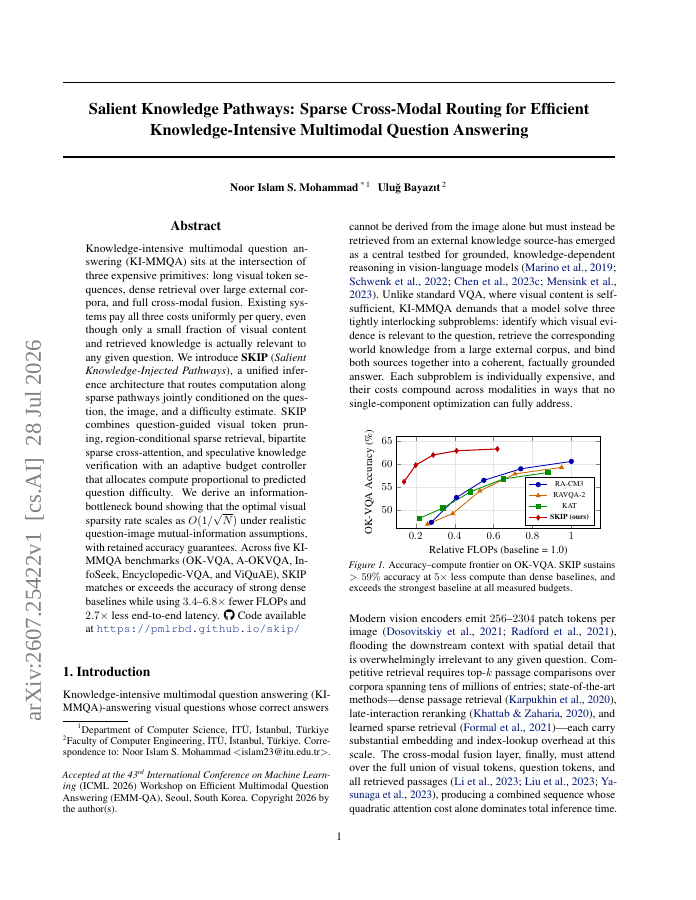
Knowledge-intensive multimodal question answering (KI-MMQA) sits at the intersection of three expensive primitives: long visual token sequences, dense retrieval over large external corpora, and full cross-modal fusion. Existing systems pay all three costs uniformly per query, even though only a small fraction of visual content and retrieved knowledge is actually relevant to any given question. We introduce SKIP (Salient Knowledge-Injected Pathways), a unified inference architecture that routes computation along sparse pathways jointly conditioned on the question, the image, and a difficulty estimate. SKIP combines question-guided visual token pruning, region-conditional sparse retrieval, bipartite sparse cross-attention, and speculative knowledge verification with an adaptive budget controller that allocates compute proportional to predicted question difficulty. We derive an information-bottleneck bound showing that the optimal visual sparsity rate scales as O(1/\sqrt{N}) under realistic question-image mutual-information assumptions, with retained accuracy guarantees. Across five KI-MMQA benchmarks (OK-VQA, A-OKVQA, InfoSeek, Encyclopedic-VQA, and ViQuAE), SKIP matches or exceeds the accuracy of strong dense baselines while using 3.4--6.8\times fewer FLOPs and 2.7\times less end-to-end latency. Code available at: https://pmlrbd.github.io/skip/
Salient Knowledge Pathways: Sparse Cross-Modal Routing for Efficient Knowledge-Intensive Multimodal Question Answering
Knowledge-intensive multimodal question answering (KI-MMQA) sits at the intersection of three expensive primitives: long visual token sequences, dense retrieval over large external corpora, and full cross-modal fusion.
- Preview
- Year
- 2026
- Hosting
- Full text hostedCC-BY-4.0
Cite
Notes
Only stored in your browser.
Attribution
- Abstract & full text
- arxiv.org/abs/2607.25422CC-BY-4.0
- TL;DR
- Semantic Scholar