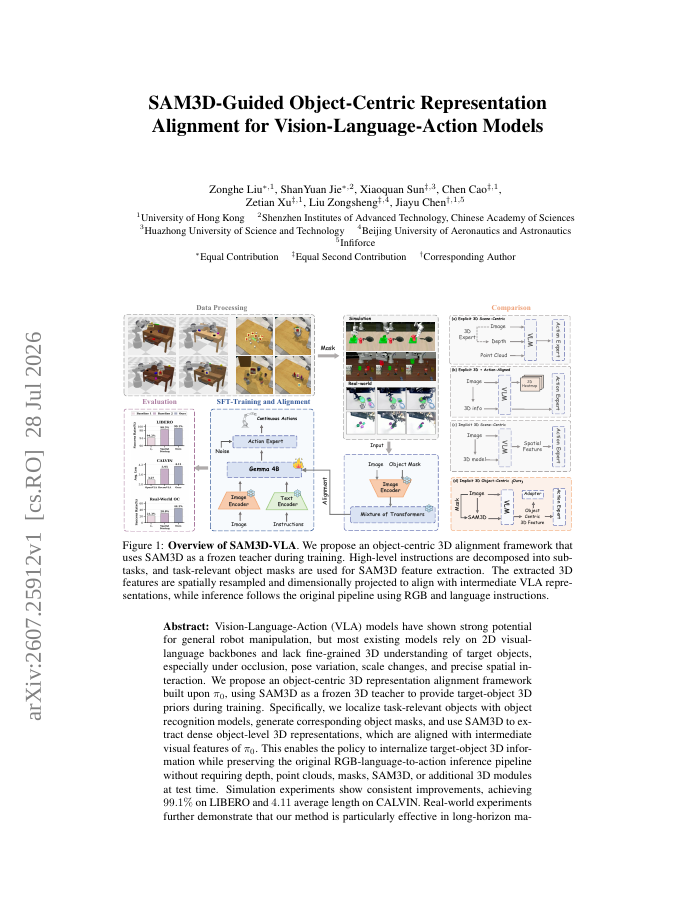
Vision-Language-Action (VLA) models have shown strong potential for general robot manipulation, but most existing models rely on 2D visual-language backbones and lack fine-grained 3D understanding of target objects, especially under occlusion, pose variation, scale changes, and precise spatial interaction. We propose an object-centric 3D representation alignment framework built upon π_0, using SAM3D as a frozen 3D teacher to provide target-object 3D priors during training. Specifically, we localize task-relevant objects with object recognition models, generate corresponding object masks, and use SAM3D to extract dense object-level 3D representations, which are aligned with intermediate visual features of π_0. This enables the policy to internalize target-object 3D information while preserving the original RGB-language-to-action inference pipeline without requiring depth, point clouds, masks, SAM3D, or additional 3D modules at test time. Simulation experiments show consistent improvements, achieving 99.1% on LIBERO and an average length of 4.11 on CALVIN. Real-world experiments further demonstrate that our method is particularly effective in long-horizon manipulation scenarios where the robot must focus on different target objects across multiple subtasks.
SAM3D-Guided Object-Centric Representation Alignment for Vision-Language-Action Models
Vision-Language-Action (VLA) models have shown strong potential for general robot manipulation, but most existing models rely on 2D visual-language backbones and lack fine-grained 3D understanding of target objects, especially under occlusion, pose variation, scale changes, and…
- Preview
- Year
- 2026
- Hosting
- Abstract onlyARXIV-DEFAULT
Cite
Notes
Only stored in your browser.
Attribution
- Abstract & full text
- arxiv.org/abs/2607.25912ARXIV-DEFAULT
- TL;DR
- Semantic Scholar