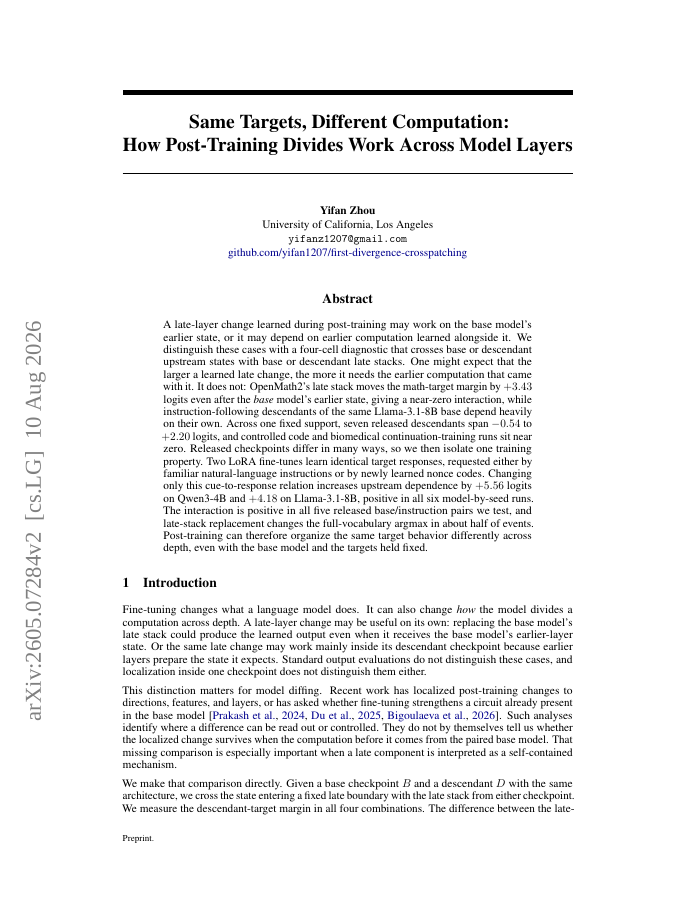
A late-layer change learned during post-training may work on the base model's earlier state, or it may depend on earlier computation learned with it. We distinguish these cases with a four-cell diagnostic that crosses base or descendant upstream states with base or descendant late stacks. A large late-stack effect need not imply strong upstream dependence. On math prompts, OpenMath2's late stack changes the target margin by +3.43 logits after base upstream state and +3.28 after its own, giving a near-zero interaction. Several instruction-following descendants of the same Llama-3.1-8B base show greater dependence, while controlled code and biomedical continuation-training runs sit near zero on the common support; seven released descendants span -0.54 to +2.20 logits. Because those checkpoints differ in many ways, we then isolate one training property. Two LoRA fine-tunes learn identical target responses requested either by familiar natural-language instructions or by newly learned nonce codes. Changing only this cue-to-response relation increases upstream dependence by +5.56 logits on Qwen3-4B and +4.18 on Llama-3.1-8B, with a positive paired shift in all six model-by-seed runs. The interaction is also positive in all five released base/instruction pairs we test, and late-stack replacement changes the full-vocabulary argmax in about half of events. Post-training can therefore organize the same target behavior with different dependencies between earlier and later computation. The diagnostic measures local next-token compatibility, not free-running component transplantation.
Same Targets, Different Computation: How Post-Training Divides Work Across Model Layers
A late-layer change learned during post-training may work on the base model's earlier state, or it may depend on earlier computation learned with it. We distinguish these cases with a four-cell diagnostic that crosses base or descendant upstream states with base or descendant…
- Preview
- Year
- 2026
- Hosting
- Full text hostedCC-BY-4.0
Cite
Notes
Only stored in your browser.
Attribution
- Abstract & full text
- arxiv.org/abs/2605.07284CC-BY-4.0
- TL;DR
- Semantic Scholar