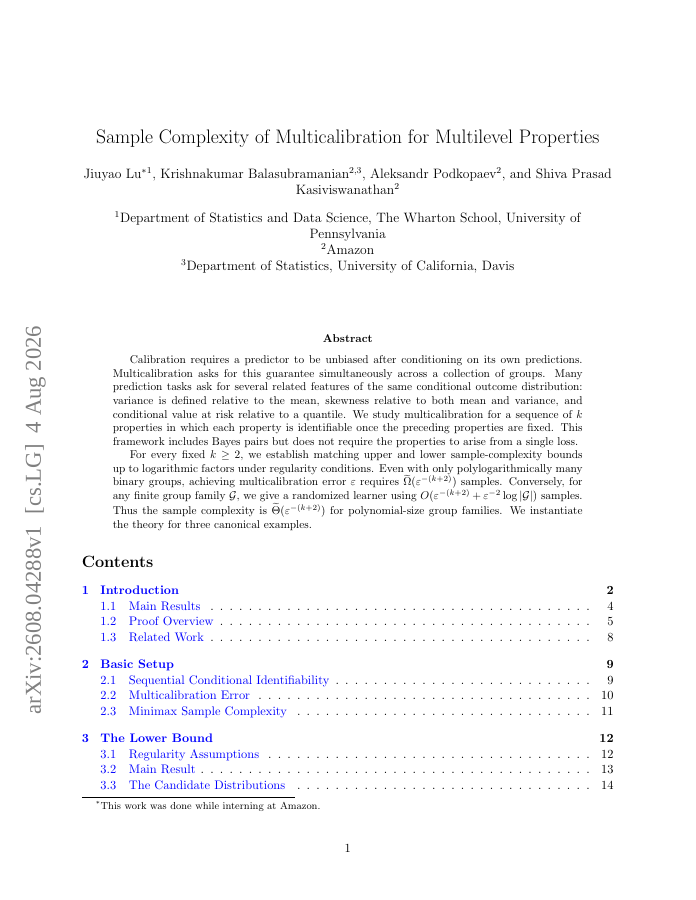
Calibration requires a predictor to be unbiased after conditioning on its own predictions. Multicalibration asks for this guarantee simultaneously across a collection of groups. Many prediction tasks ask for several related features of the same conditional outcome distribution: variance is defined relative to the mean, skewness relative to both mean and variance, and conditional value at risk relative to a quantile. We study multicalibration for a sequence of k properties in which each property is identifiable once the preceding properties are fixed. This framework includes Bayes pairs but does not require the properties to arise from a single loss. For every fixed k\ge2, we establish matching upper and lower sample-complexity bounds up to logarithmic factors under regularity conditions. Even with only polylogarithmically many binary groups, achieving multicalibration error \varepsilon requires \widetildeΩ(\varepsilon^{-(k+2)}) samples. Conversely, for any finite group family \mathcal G, we give a randomized learner using O(\varepsilon^{-(k+2)}+\varepsilon^{-2}\log|\mathcal G|) samples. Thus the sample complexity is \widetildeΘ(\varepsilon^{-(k+2)}) for polynomial-size group families. We instantiate the theory for three canonical examples.
Sample Complexity of Multicalibration for Multilevel Properties
Calibration requires a predictor to be unbiased after conditioning on its own predictions. Multicalibration asks for this guarantee simultaneously across a collection of groups.
- Preview
- Year
- 2026
- Hosting
- Abstract onlyARXIV-DEFAULT
Cite
Notes
Only stored in your browser.
Attribution
- Abstract & full text
- arxiv.org/abs/2608.04288ARXIV-DEFAULT
- TL;DR
- Semantic Scholar