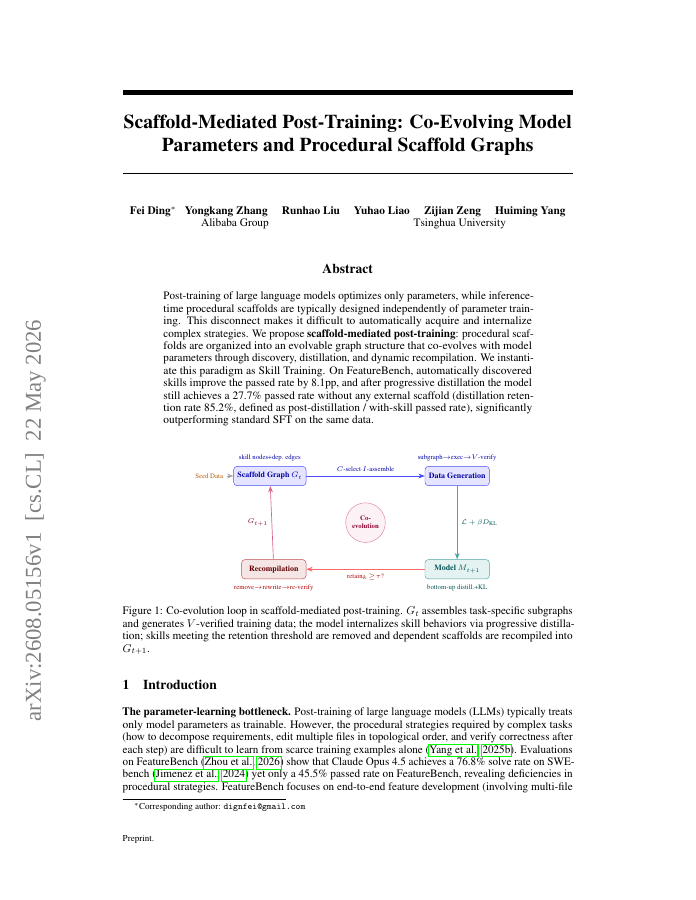
Post-training of large language models optimizes only parameters, while inference-time procedural scaffolds are typically designed independently of parameter training. This disconnect makes it difficult to automatically acquire and internalize complex strategies. We propose scaffold-mediated post-training: procedural scaffolds are organized into an evolvable graph structure that co-evolves with model parameters through discovery, distillation, and dynamic recompilation. We instantiate this paradigm as Skill Training. On FeatureBench, automatically discovered skills improve the passed rate by 8.1pp, and after progressive distillation the model still achieves a 27.7% passed rate without any external scaffold (distillation retention rate 85.2%, defined as post-distillation / with-skill passed rate), significantly outperforming standard SFT on the same data.
Scaffold-Mediated Post-Training: Co-Evolving Model Parameters and Procedural Scaffold Graphs
Post-training of large language models optimizes only parameters, while inference-time procedural scaffolds are typically designed independently of parameter training. This disconnect makes it difficult to automatically acquire and internalize complex strategies.
- Preview
- Year
- 2026
- Hosting
- Excerpt onlyCC-BY-NC-4.0
Cite
Notes
Only stored in your browser.
Attribution
- Abstract & full text
- arxiv.org/abs/2608.05156CC-BY-NC-4.0
- TL;DR
- Semantic Scholar