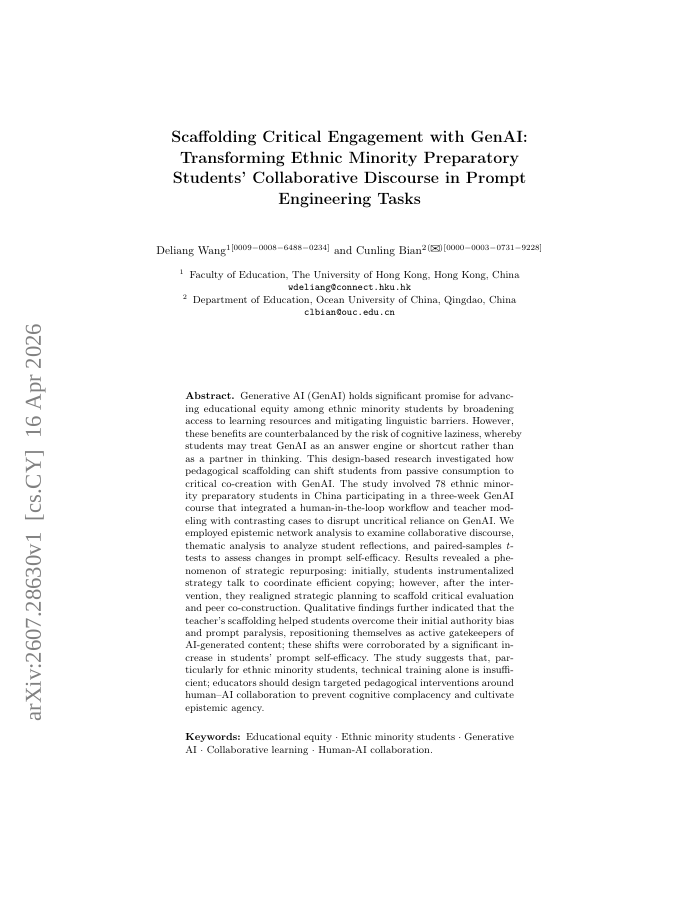
Generative AI (GenAI) holds significant promise for advancing educational equity among ethnic minority students by broadening access to learning resources and mitigating linguistic barriers. However, these benefits are counterbalanced by the risk of cognitive laziness, whereby students may treat GenAI as an answer engine or shortcut rather than as a partner in thinking. This design-based research investigated how pedagogical scaffolding can shift students from passive consumption to critical co-creation with GenAI. The study involved 78 ethnic minority preparatory students in China participating in a three-week GenAI course that integrated a human-in-the-loop workflow and teacher modeling with contrasting cases to disrupt uncritical reliance on GenAI. We employed epistemic network analysis to examine collaborative discourse, thematic analysis to analyze student reflections, and paired-samples t-tests to assess changes in prompt self-efficacy. Results revealed a phenomenon of strategic repurposing: initially, students instrumentalized strategy talk to coordinate efficient copying; however, after the intervention, they realigned strategic planning to scaffold critical evaluation and peer co-construction. Qualitative findings further indicated that the teacher's scaffolding helped students overcome their initial authority bias and prompt paralysis, repositioning themselves as active gatekeepers of AI-generated content; these shifts were corroborated by a significant increase in students' prompt self-efficacy. The study suggests that, particularly for ethnic minority students, technical training alone is insufficient; educators should design targeted pedagogical interventions around human-AI collaboration to prevent cognitive complacency and cultivate epistemic agency.
Scaffolding Critical Engagement with GenAI: Transforming Ethnic Minority Preparatory Students' Collaborative Discourse in Prompt Engineering Tasks
Generative AI (GenAI) holds significant promise for advancing educational equity among ethnic minority students by broadening access to learning resources and mitigating linguistic barriers.
- Preview
- Year
- 2026
- Hosting
- Excerpt onlyCC-BY-NC-SA-4.0
Cite
Notes
Only stored in your browser.
Attribution
- Abstract & full text
- arxiv.org/abs/2607.28630CC-BY-NC-SA-4.0
- TL;DR
- Semantic Scholar