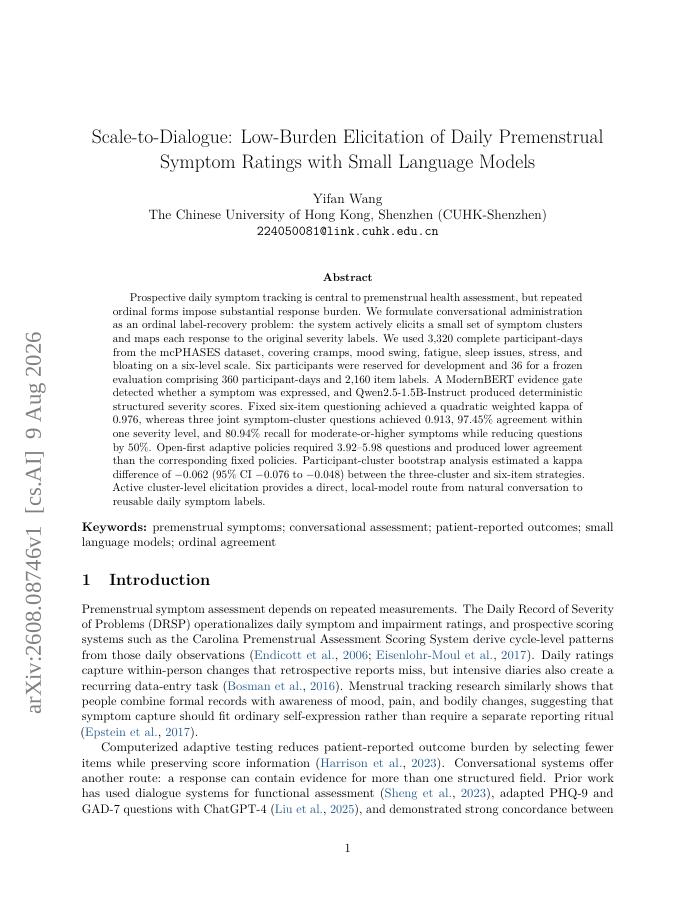
Prospective daily symptom tracking is central to premenstrual health assessment, but repeated ordinal forms impose substantial response burden. We formulate conversational administration as an ordinal label-recovery problem: the system actively elicits a small set of symptom clusters and maps each response to the original severity labels. We used 3,320 complete participant-days from the mcPHASES dataset, covering cramps, mood swing, fatigue, sleep issues, stress, and bloating on a six-level scale. Six participants were reserved for development and 36 for a frozen evaluation comprising 360 participant-days and 2,160 item labels. A ModernBERT evidence gate detected whether a symptom was expressed, and Qwen2.5-1.5B-Instruct produced deterministic structured severity scores. Fixed six-item questioning achieved a quadratic weighted kappa of 0.976, whereas three joint symptom-cluster questions achieved 0.913, 97.45% agreement within one severity level, and 80.94% recall for moderate-or-higher symptoms while reducing questions by 50%. Open-first adaptive policies required 3.92-5.98 questions and produced lower agreement than the corresponding fixed policies. Participant-cluster bootstrap analysis estimated a kappa difference of -0.062 (95% CI -0.076 to -0.048) between the three-cluster and six-item strategies. Active cluster-level elicitation provides a direct, local-model route from natural conversation to reusable daily symptom labels.
Scale-to-Dialogue: Low-Burden Elicitation of Daily Premenstrual Symptom Ratings with Small Language Models
Prospective daily symptom tracking is central to premenstrual health assessment, but repeated ordinal forms impose substantial response burden. We formulate conversational administration as an ordinal label-recovery problem: the system actively elicits a small set of symptom…
- Preview
- Year
- 2026
- Hosting
- Full text hostedCC-BY-4.0
Cite
Notes
Only stored in your browser.
Attribution
- Abstract & full text
- arxiv.org/abs/2608.08746CC-BY-4.0
- TL;DR
- Semantic Scholar