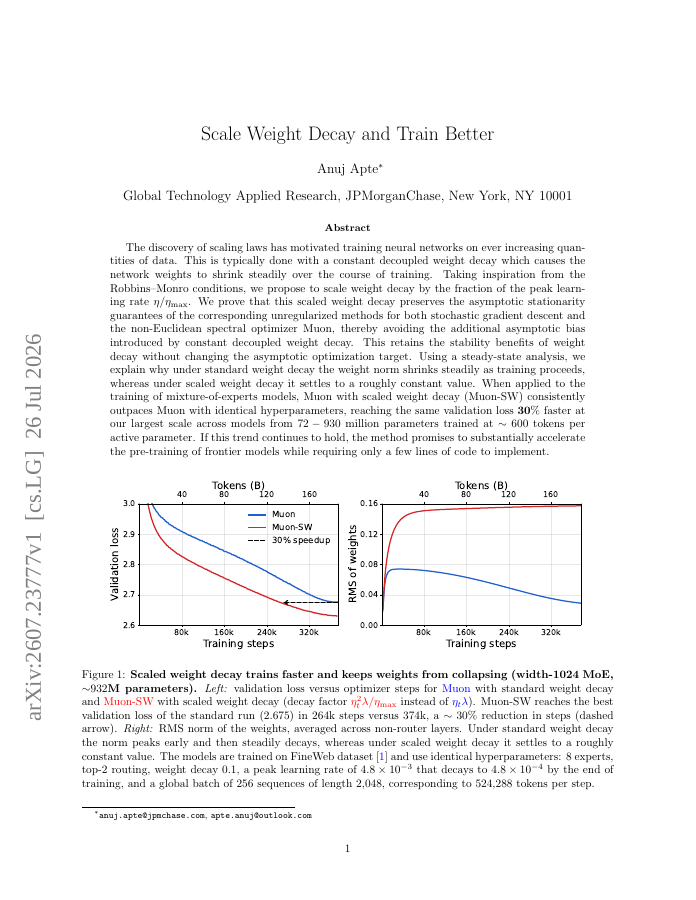
The discovery of scaling laws has motivated training neural networks on ever increasing quantities of data. This is typically done with a constant decoupled weight decay which causes the network weights to shrink steadily over the course of training. Taking inspiration from the Robbins--Monro conditions, we propose to scale weight decay by the fraction of the peak learning rate η/η_{\max}. We prove that this scaled weight decay preserves the asymptotic stationarity guarantees of the corresponding unregularized methods for both stochastic gradient descent and the non-Euclidean spectral optimizer Muon, thereby avoiding the additional asymptotic bias introduced by constant decoupled weight decay. This retains the stability benefits of weight decay without changing the asymptotic optimization target. Using a steady-state analysis, we explain why under standard weight decay the weight norm shrinks steadily as training proceeds, whereas under scaled weight decay it settles to a roughly constant value. When applied to the training of mixture-of-experts models, Muon with scaled weight decay (Muon-SW) consistently outpaces Muon with identical hyperparameters, reaching the same validation loss 30% faster at our largest scale across models from 72 - 930 million parameters trained at \sim 600 tokens per active parameter. If this trend continues to hold, the method promises to substantially accelerate the pre-training of frontier models while requiring only a few lines of code to implement.
Scale Weight Decay and Train Better
The discovery of scaling laws has motivated training neural networks on ever increasing quantities of data. This is typically done with a constant decoupled weight decay which causes the network weights to shrink steadily over the course of training.
- Preview
- Year
- 2026
- Hosting
- Abstract onlyARXIV-DEFAULT
Cite
Notes
Only stored in your browser.
Attribution
- Abstract & full text
- arxiv.org/abs/2607.23777ARXIV-DEFAULT
- TL;DR
- Semantic Scholar