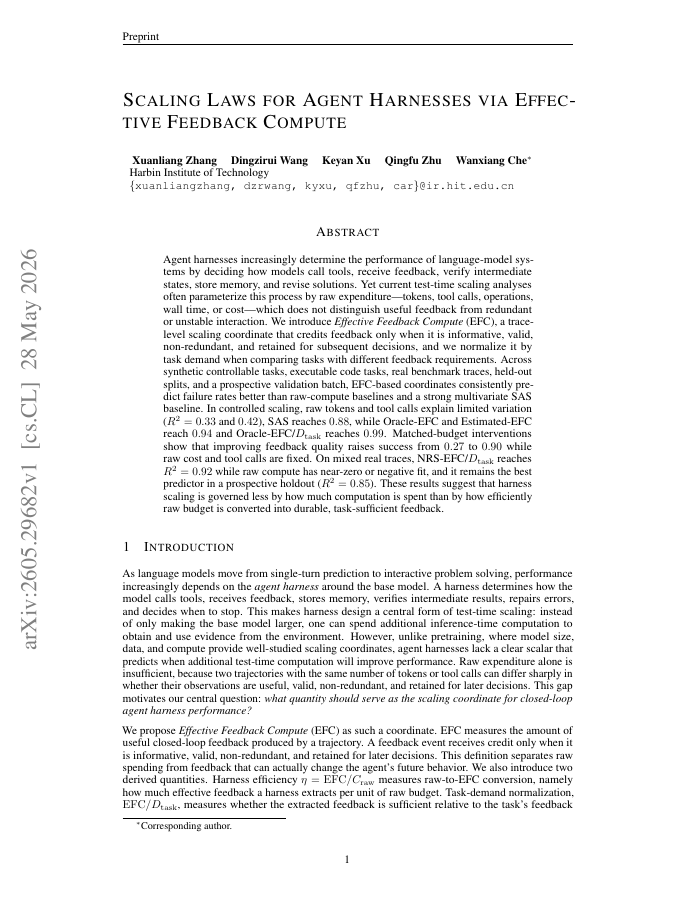
Agent harnesses shape language-model performance by controlling tool use, feedback, verification, memory, and repair. Yet raw test-time expenditure, such as tokens, tool calls, wall time, or cost, cannot distinguish useful feedback from redundant or unstable interaction. We introduce Effective Feedback Compute (EFC), a trace-level scaling coordinate for informative, valid, non-redundant, and retained feedback. We further define Estimated-EFC, NRS-EFC, harness efficiency η, and task-demand normalization for realistic traces and heterogeneous tasks. Across synthetic, real, held-out, and prospective evaluations, EFC-based coordinates outperform raw-compute baselines and SAS. Oracle-EFC/D_{task} reaches R^2=0.99 in controlled scaling, and NRS-EFC/D_{task} reaches R^2=0.93 on real traces where raw compute has near-zero or negative fit. Finally, \ours uses EFC as a companion control layer for existing harnesses, improving mean pass rate from 61.2% to 68.2% while reducing mean raw cost from 213.8 to 85.1 under matched settings. These results suggest that harness scaling depends on durable, task-sufficient feedback rather than raw computation alone.
Scaling Laws for Agent Harnesses via Effective Feedback Compute
Agent harnesses shape language-model performance by controlling tool use, feedback, verification, memory, and repair. Yet raw test-time expenditure, such as tokens, tool calls, wall time, or cost, cannot distinguish useful feedback from redundant or unstable interaction.
- Preview
- Year
- 2026
- Hosting
- Excerpt onlyCC-BY-NC-4.0
Cite
Notes
Only stored in your browser.
Attribution
- Abstract & full text
- arxiv.org/abs/2605.29682CC-BY-NC-4.0
- TL;DR
- Semantic Scholar