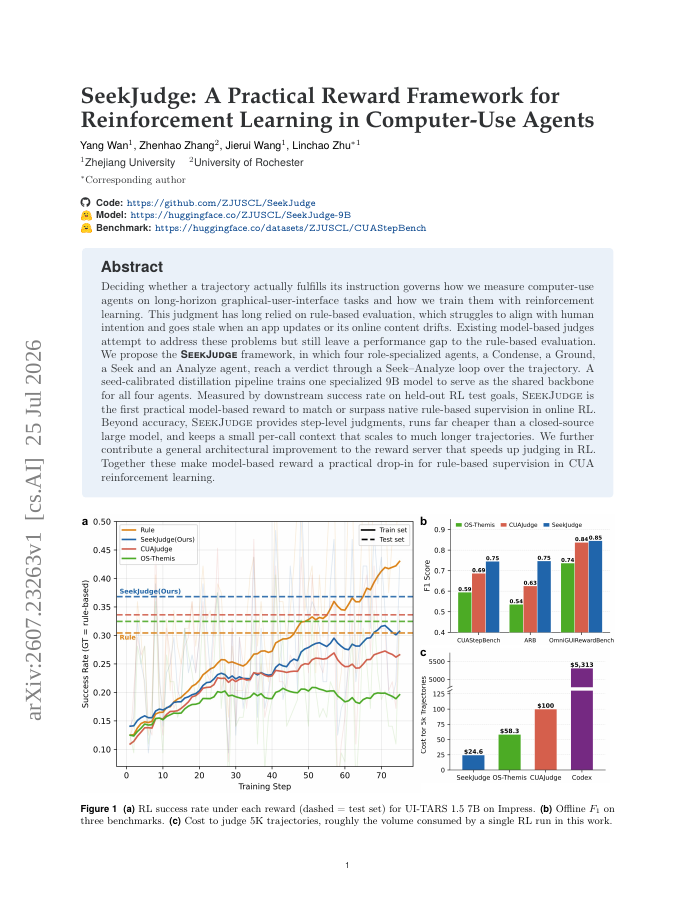
Deciding whether a trajectory actually fulfills its instruction governs how we measure computer-use agents on long-horizon graphical-user-interface tasks and how we train them with reinforcement learning. This judgment has long relied on rule-based evaluation, which struggles to align with human intention and goes stale when an app updates or its online content drifts. Existing model-based judges attempt to address these problems but still leave a performance gap to the rule-based evaluation. We propose the SeekJudge framework, in which four role-specialized agents, a Condense, a Ground, a Seek and an Analyze agent, reach a verdict through a Seek--Analyze loop over the trajectory. A seed-calibrated distillation pipeline trains one specialized 9B model to serve as the shared backbone for all four agents. Measured by downstream success rate on held-out RL test goals, SeekJudge is the first practical model-based reward to match or surpass native rule-based supervision in online RL. Beyond accuracy, SeekJudge provides step-level judgments, runs far cheaper than a closed-source large model, and keeps a small per-call context that scales to much longer trajectories. We further contribute a general architectural improvement to the reward server that speeds up judging in RL. Together these make model-based reward a practical drop-in for rule-based supervision in CUA reinforcement learning.
SeekJudge: A Practical Reward Framework for Reinforcement Learning in Computer-Use Agents
Deciding whether a trajectory actually fulfills its instruction governs how we measure computer-use agents on long-horizon graphical-user-interface tasks and how we train them with reinforcement learning.
- Preview
- Year
- 2026
- Hosting
- Full text hostedCC-BY-4.0
Cite
Notes
Only stored in your browser.
Attribution
- Abstract & full text
- arxiv.org/abs/2607.23263CC-BY-4.0
- TL;DR
- Semantic Scholar