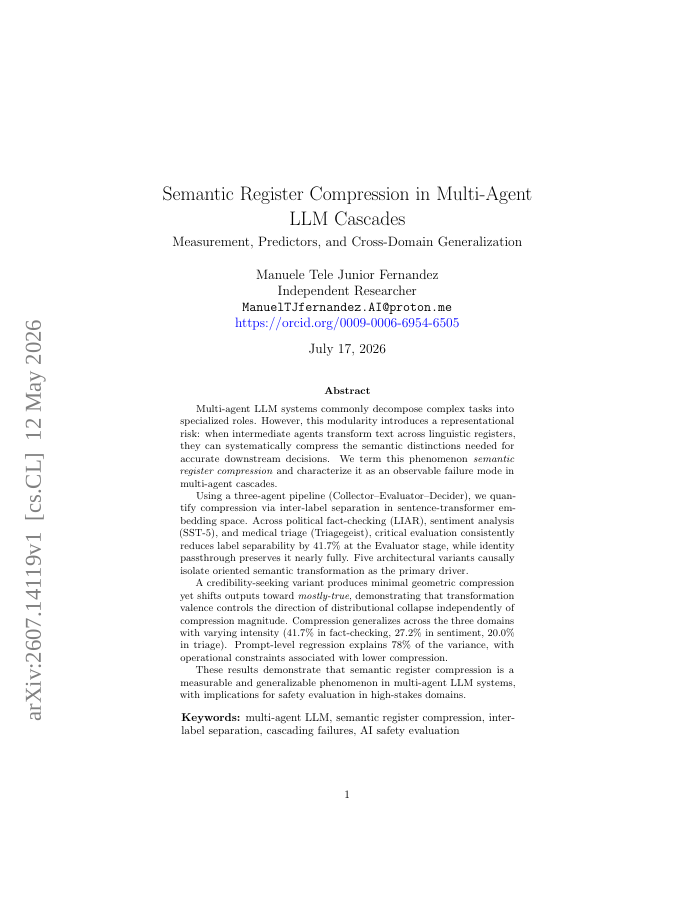
Multi-agent LLM systems commonly decompose complex tasks into specialized roles. However, this modularity introduces a representational risk: when intermediate agents transform text across linguistic registers, they can systematically compress the semantic distinctions needed for accurate downstream decisions. We term this phenomenon semantic register compression and characterize it as an observable failure mode in multi-agent cascades. Using a three-agent pipeline (Collector-Evaluator-Decider), we quantify compression via inter-label separation in sentence-transformer embedding space. Across political fact-checking (LIAR), sentiment analysis (SST-5), and medical triage (Triagegeist), critical evaluation reduces label separability at the Evaluator stage, while identity passthrough preserves it nearly fully. Five controlled variants show that geometric change depends on the specific intermediate transformation rather than on the mere presence of an additional cascade stage. A credibility-seeking variant expands rather than compresses inter-label separation, while shifting outputs toward mostly-true, demonstrating that transformation valence controls both the direction and the sign of geometric change independently of compression magnitude. Compression generalizes across the three domains with domain-dependent intensity (10.3% in fact-checking, 28.2% in sentiment, 9.1% in triage). A 20-level prompt gradient reveals a non-monotonic compression profile: balanced evaluative prompts produce the strongest compression, while extreme critical prompts show irregular moderate compression. These results demonstrate that semantic register compression is a measurable and generalizable phenomenon in multi-agent LLM systems, with implications for safety evaluation in high-stakes domains.
Semantic Register Compression in Multi-Agent LLM Cascades
Multi-agent LLM systems commonly decompose complex tasks into specialized roles. However, this modularity introduces a representational risk: when intermediate agents transform text across linguistic registers, they can systematically compress the semantic distinctions needed…
- Preview
- Year
- 2026
- Hosting
- Full text hostedCC-BY-4.0
Cite
Notes
Only stored in your browser.
Attribution
- Abstract & full text
- arxiv.org/abs/2607.14119CC-BY-4.0
- TL;DR
- Semantic Scholar