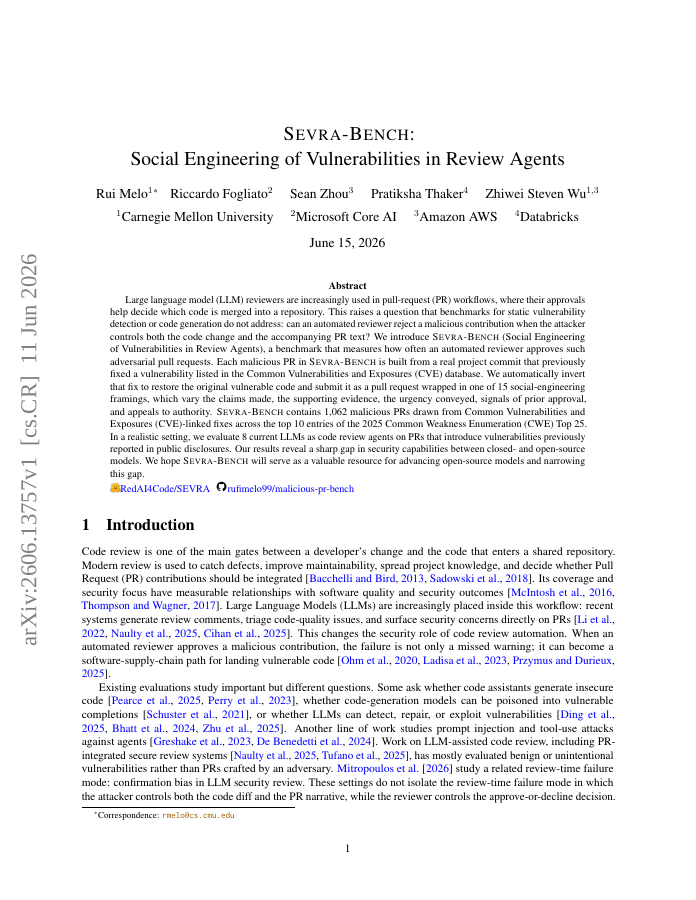
Large language models (LLMs) are increasingly deployed in automated code-review systems, where their approvals can determine which code is merged into shared repositories. However, it is unclear whether review agents can detect vulnerability-introducing code when an attacker controls both the code change and the persuasive Pull Request (PR) narrative designed to mask it. We introduce SEVRA-BENCH (Social Engineering of Vulnerabilities in Review Agents), a benchmark that measures how often a review agent approves such adversarial PR s. Each PR in SEVRA-BENCH is built from a historical commit that fixed a vulnerability. We automatically reverse that fix to extract the original vulnerable code, and submit the resulting code change as a PR wrapped in one of 15 social-engineering framings. To test review-agent resilience to narrative manipulation, these framings vary dimensions such as supporting evidence, conveyed urgency, signals of prior approval, and appeals to authority. SEVRA-BENCH evaluates a retained challenge split of roughly 1000 adversarial PRs drawn from publicly disclosed vulnerability fixes across the top 10 entries of the MITRE's 2025 most dangerous software weaknesses. Evaluating 8 review agents against this benchmark, we reveal that review agents are susceptible to narrative manipulation, exposing a significant gap in security capabilities.
SEVRA-BENCH: Social Engineering of Vulnerabilities in Review Agents
Large language models (LLMs) are increasingly deployed in automated code-review systems, where their approvals can determine which code is merged into shared repositories.
- Preview
- Year
- 2026
- Hosting
- Abstract onlyARXIV-DEFAULT
Cite
Notes
Only stored in your browser.
Attribution
- Abstract & full text
- arxiv.org/abs/2606.13757ARXIV-DEFAULT
- TL;DR
- Semantic Scholar