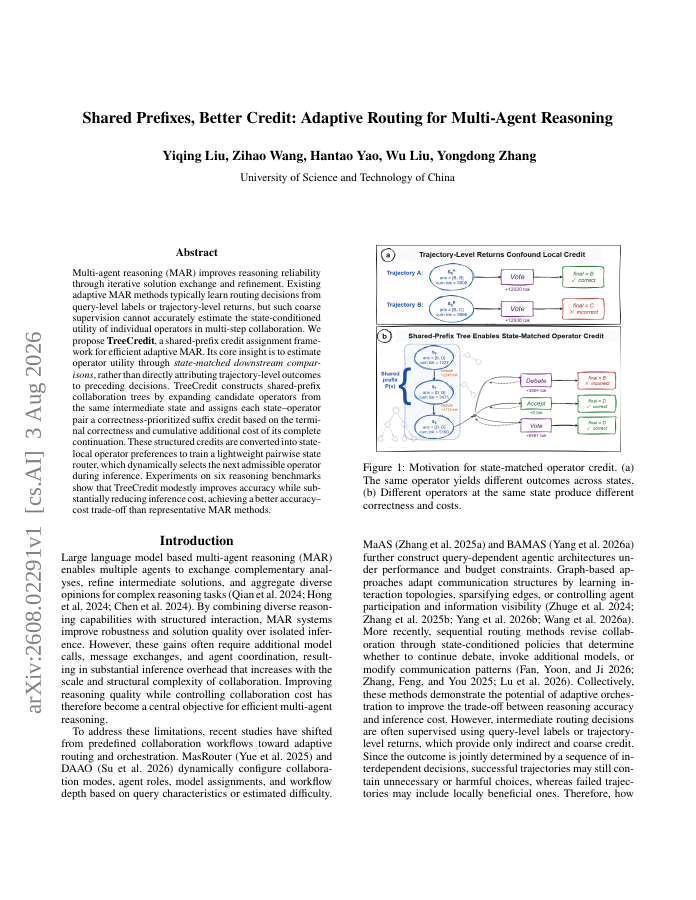
Multi-agent reasoning (MAR) improves reasoning reliability through iterative solution exchange and refinement. Existing adaptive MAR methods typically learn routing decisions from query-level labels or trajectory-level returns, but such coarse supervision cannot accurately estimate the state-conditioned utility of individual operators in multi-step collaboration. We propose TreeCredit, a shared-prefix credit assignment framework for efficient adaptive MAR. Its core insight is to estimate operator utility through state-matched downstream comparisons, rather than directly attributing trajectory-level outcomes to preceding decisions. TreeCredit constructs shared-prefix collaboration trees by expanding candidate operators from the same intermediate state and assigns each state--operator pair a correctness-prioritized suffix credit based on the terminal correctness and cumulative additional cost of its complete continuation. These structured credits are converted into state-local operator preferences to train a lightweight pairwise state router, which dynamically selects the next admissible operator during inference. Experiments on six reasoning benchmarks show that TreeCredit modestly improves accuracy while substantially reducing inference cost, achieving a better accuracy--cost trade-off than representative MAR methods.
Shared Prefixes, Better Credit: Adaptive Routing for Multi-Agent Reasoning
Multi-agent reasoning (MAR) improves reasoning reliability through iterative solution exchange and refinement. Existing adaptive MAR methods typically learn routing decisions from query-level labels or trajectory-level returns, but such coarse supervision cannot accurately…
- Preview
- Year
- 2026
- Hosting
- Abstract onlyARXIV-DEFAULT
Cite
Notes
Only stored in your browser.
Attribution
- Abstract & full text
- arxiv.org/abs/2608.02291ARXIV-DEFAULT
- TL;DR
- Semantic Scholar