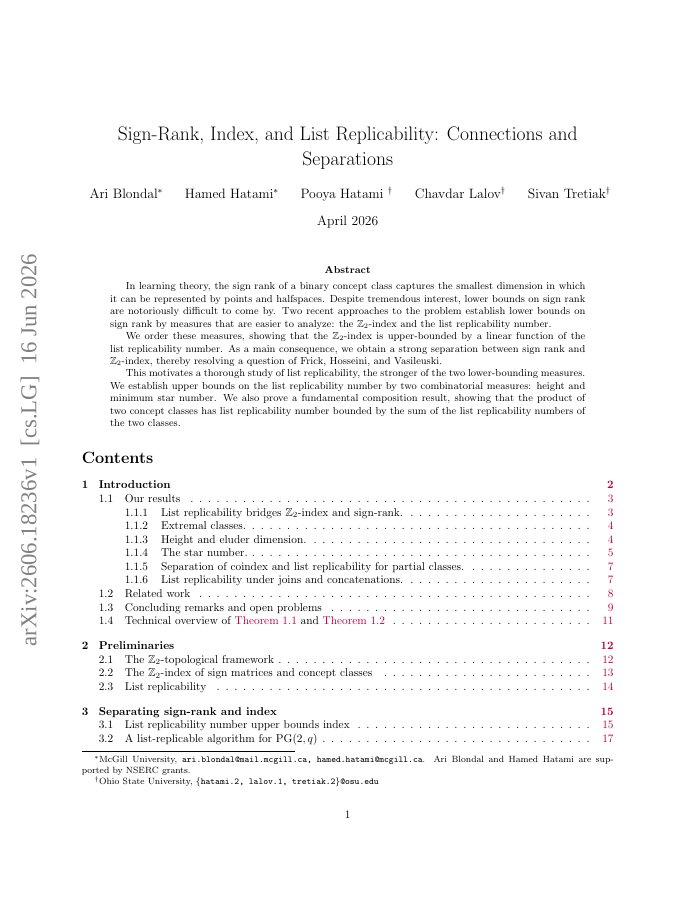
In learning theory, the sign-rank of a binary concept class captures the smallest dimension in which it can be represented by points and halfspaces. Despite tremendous interest, lower bounds on sign-rank are notoriously difficult to come by. Two recent approaches to the problem establish lower bounds on sign-rank by measures that are easier to analyze: the \mathbb{Z}_2-index and the list replicability number. We order these measures, showing that the \mathbb{Z}_2-index is upper-bounded by a linear function of the list replicability number. As a main consequence, we obtain a strong separation between sign-rank and \mathbb{Z}_2-index, thereby resolving a question of Frick, Hosseini, and Vasileuski. This motivates a thorough study of list replicability, the stronger of the two lower-bounding measures. We establish upper bounds on the list replicability number by two combinatorial measures: height and minimum star number. We also prove a fundamental composition result, showing that the product of two concept classes has list replicability number bounded by the sum of the list replicability numbers of the two classes.
Sign-Rank, Index, and List Replicability: Connections and Separations
In learning theory, the sign-rank of a binary concept class captures the smallest dimension in which it can be represented by points and halfspaces. Despite tremendous interest, lower bounds on sign-rank are notoriously difficult to come by.
- Preview
- Year
- 2026
- Hosting
- Abstract onlyARXIV-DEFAULT
Cite
Notes
Only stored in your browser.
Attribution
- Abstract & full text
- arxiv.org/abs/2606.18236ARXIV-DEFAULT
- TL;DR
- Semantic Scholar