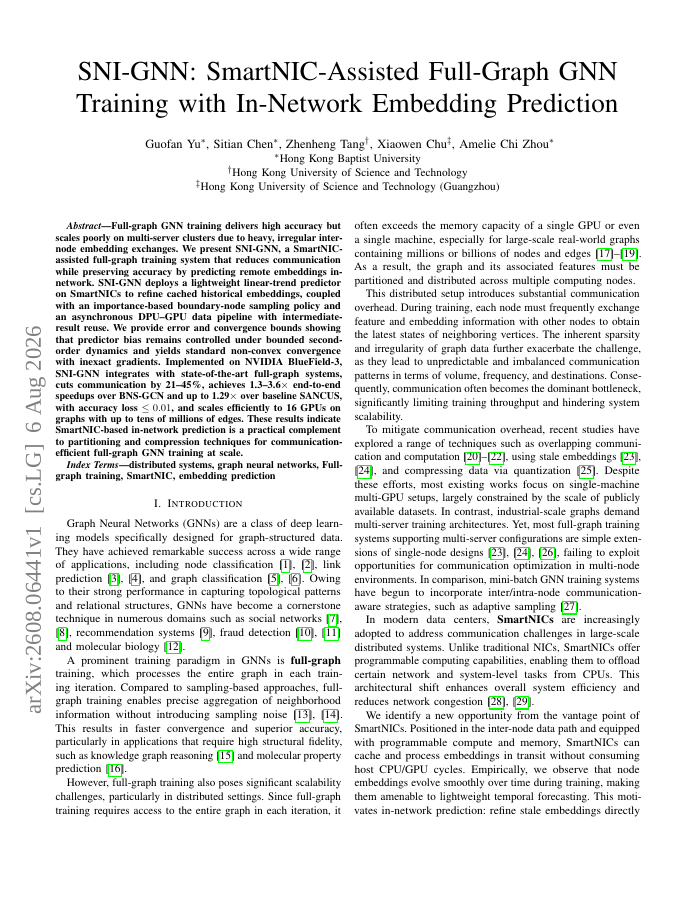
Full-graph GNN training delivers high accuracy but scales poorly on multi-server clusters due to heavy, irregular inter-node embedding exchanges. We present SNI-GNN, a SmartNIC-assisted full-graph training system that reduces communication while preserving accuracy by predicting remote embeddings in-network. SNI-GNN deploys a lightweight linear-trend predictor on SmartNICs to refine cached historical embeddings, coupled with an importance-based boundary-node sampling policy and an asynchronous DPU--GPU data pipeline with intermediate-result reuse. We provide error and convergence bounds showing that predictor bias remains controlled under bounded second-order dynamics and yields standard non-convex convergence with inexact gradients. Implemented on NVIDIA BlueField-3, SNI-GNN integrates with state-of-the-art full-graph systems, cuts communication by 21--45%, achieves 1.3--3.6\times end-to-end speedups over BNS-GCN and up to 1.29\times over baseline SANCUS, with accuracy loss \leq 0.01, and scales efficiently to 16 GPUs on graphs with up to tens of millions of edges. These results indicate SmartNIC-based in-network prediction is a practical complement to partitioning and compression techniques for communication-efficient full-graph GNN training at scale.
SNI-GNN: SmartNIC-Assisted Full-Graph GNN Training with In-Network Embedding Prediction
Full-graph GNN training delivers high accuracy but scales poorly on multi-server clusters due to heavy, irregular inter-node embedding exchanges. We present SNI-GNN, a SmartNIC-assisted full-graph training system that reduces communication while preserving accuracy by predicting…
- Preview
- Year
- 2026
- Hosting
- Abstract onlyARXIV-DEFAULT
Cite
Notes
Only stored in your browser.
Attribution
- Abstract & full text
- arxiv.org/abs/2608.06441ARXIV-DEFAULT
- TL;DR
- Semantic Scholar