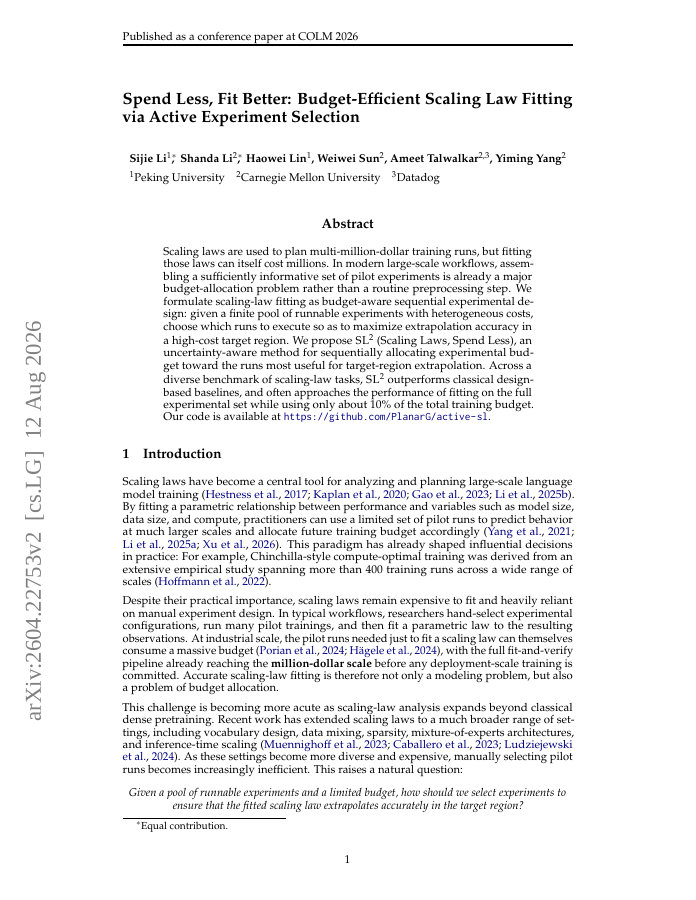
Scaling laws are used to plan multi-million-dollar training runs, but fitting those laws can itself cost millions. In modern large-scale workflows, assembling a sufficiently informative set of pilot experiments is already a major budget-allocation problem rather than a routine preprocessing step. We formulate scaling-law fitting as budget-aware sequential experimental design: given a finite pool of runnable experiments with heterogeneous costs, choose which runs to execute so as to maximize extrapolation accuracy in a high-cost target region. We propose SL^2 (Scaling Laws, Spend Less), an uncertainty-aware method for sequentially allocating experimental budget toward the runs most useful for target-region extrapolation. Across a diverse benchmark of scaling-law tasks, SL^2 outperforms classical design-based baselines, and often approaches the performance of fitting on the full experimental set while using only about 10% of the total training budget. Our code is available at https://github.com/PlanarG/active-sl.
Spend Less, Fit Better: Budget-Efficient Scaling Law Fitting via Active Experiment Selection
Scaling laws are used to plan multi-million-dollar training runs, but fitting those laws can itself cost millions. In modern large-scale workflows, assembling a sufficiently informative set of pilot experiments is already a major budget-allocation problem rather than a routine…
- Preview
- Year
- 2026
- Hosting
- Full text hostedCC-BY-4.0
Cite
Notes
Only stored in your browser.
Attribution
- Abstract & full text
- arxiv.org/abs/2604.22753CC-BY-4.0
- TL;DR
- Semantic Scholar