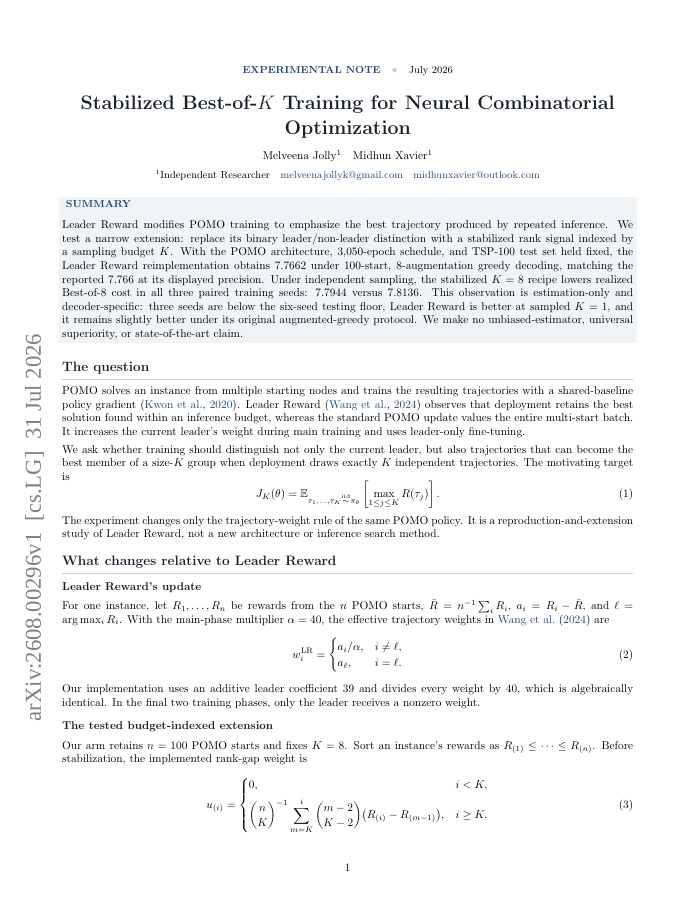
Leader Reward modifies POMO training to emphasize the best trajectory produced by repeated inference. We test a narrow extension: replace its binary leader/non-leader distinction with a stabilized rank signal indexed by a sampling budget K. With the POMO architecture, 3,050-epoch schedule, and TSP-100 test set held fixed, the Leader Reward reimplementation obtains 7.7662 under 100-start, 8-augmentation greedy decoding, matching the reported 7.766 at its displayed precision. Under independent sampling, the stabilized K=8 recipe lowers realized Best-of-8 cost in all three paired training seeds: 7.7944 versus 7.8136. This observation is estimation-only and decoder-specific: three seeds are below the six-seed testing floor, Leader Reward is better at sampled K=1, and it remains slightly better under its original augmented-greedy protocol. We make no unbiased-estimator, universal superiority, or state-of-the-art claim.
Stabilized Best-of-$K$ Training for Neural Combinatorial Optimization
Leader Reward modifies POMO training to emphasize the best trajectory produced by repeated inference. We test a narrow extension: replace its binary leader/non-leader distinction with a stabilized rank signal indexed by a sampling budget $K$.
- Preview
- Year
- 2026
- Hosting
- Full text hostedCC-BY-4.0
Cite
Notes
Only stored in your browser.
Attribution
- Abstract & full text
- arxiv.org/abs/2608.00296CC-BY-4.0
- TL;DR
- Semantic Scholar