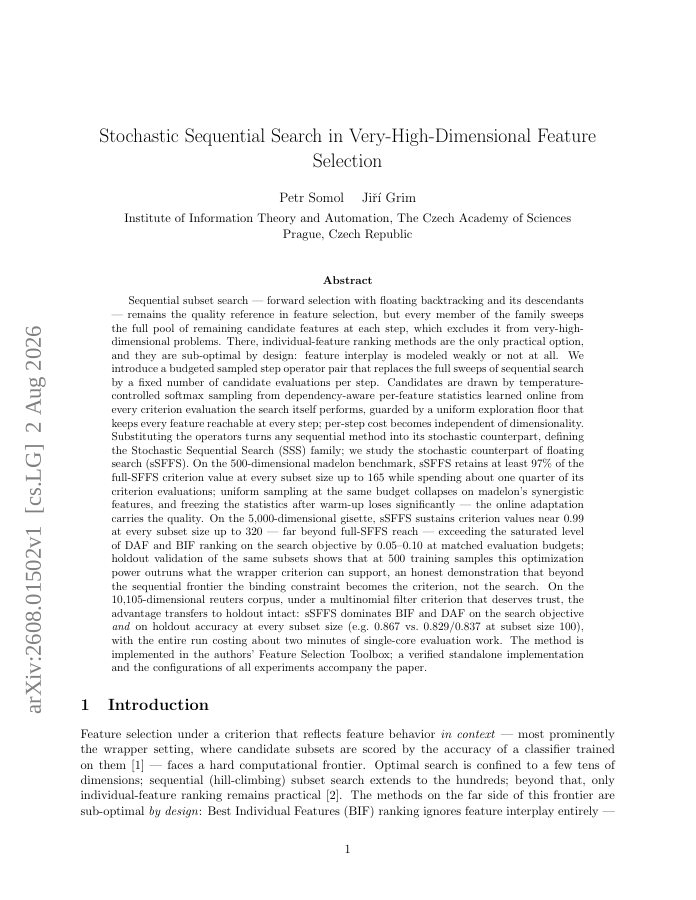
Sequential subset search -- forward selection with floating backtracking and its descendants -- remains the quality reference in feature selection, but every member of the family sweeps the full pool of remaining candidate features at each step, which excludes it from very-high-dimensional problems; there, only individual-feature ranking remains practical, and it models feature interplay weakly or not at all. We introduce a budgeted sampled step operator pair that replaces the full sweeps by a fixed number of candidate evaluations per step. Candidates are drawn by temperature-controlled softmax sampling from dependency-aware per-feature statistics learned online from every criterion evaluation the search performs, guarded by a uniform exploration floor; per-step cost becomes independent of dimensionality. Substituting the operators turns any sequential method into its stochastic counterpart, defining the Stochastic Sequential Search (SSS) family; we study the stochastic counterpart of floating search, sSFFS. On 500-dimensional madelon, sSFFS retains at least 97% of the full-SFFS criterion value at every subset size at about a quarter of its evaluations, while uniform sampling at the same budget collapses on madelon's synergistic features. On 5,000-dimensional gisette, far beyond full-SFFS reach, sSFFS exceeds the saturated criterion level of DAF and BIF ranking at matched budgets; holdout validation shows that at 500 training samples the binding constraint beyond the sequential frontier becomes the criterion, not the search. On 10,105-dimensional reuters, under a trustworthy multinomial filter criterion, sSFFS dominates BIF and DAF on the search objective and on holdout accuracy at every subset size, in about two minutes of single-core evaluation work. A verified standalone implementation accompanies the paper.
Stochastic Sequential Search in Very-High-Dimensional Feature Selection
Sequential subset search -- forward selection with floating backtracking and its descendants -- remains the quality reference in feature selection, but every member of the family sweeps the full pool of remaining candidate features at each step, which excludes it from…
- Preview
- Year
- 2026
- Hosting
- Abstract onlyARXIV-DEFAULT
Cite
Notes
Only stored in your browser.
Attribution
- Abstract & full text
- arxiv.org/abs/2608.01502ARXIV-DEFAULT
- TL;DR
- Semantic Scholar