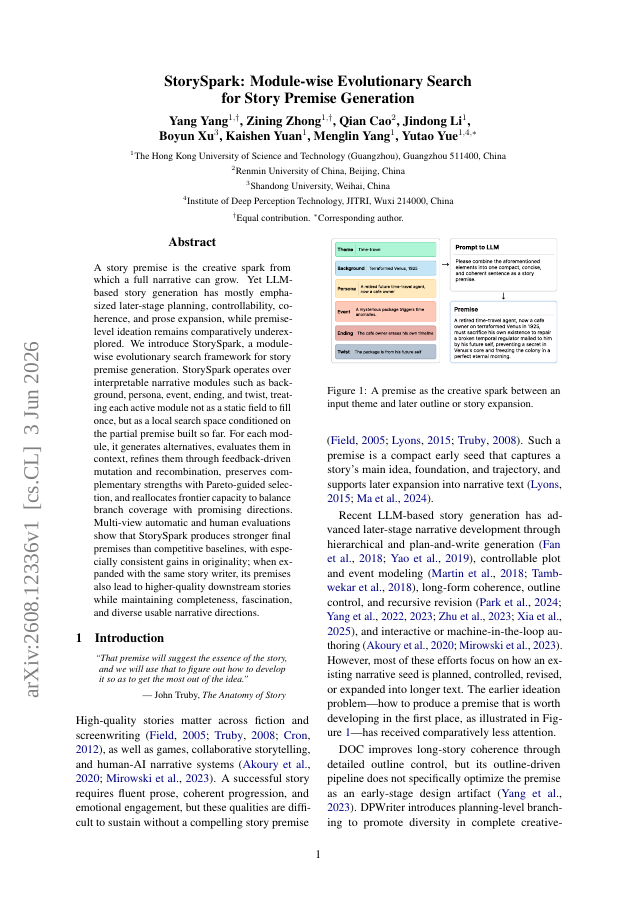
A story premise is the creative spark from which a full narrative can grow. Yet LLM-based story generation has mostly emphasized later-stage planning, controllability, coherence, and prose expansion, while premise-level ideation remains comparatively underexplored. We introduce StorySpark, a module-wise evolutionary search framework for story premise generation. StorySpark operates over interpretable narrative modules such as background, persona, event, ending, and twist, treating each active module not as a static field to fill once, but as a local search space conditioned on the partial premise built so far. For each module, it generates alternatives, evaluates them in context, refines them through feedback-driven mutation and recombination, preserves complementary strengths with Pareto-guided selection, and reallocates frontier capacity to balance branch coverage with promising directions. Multi-view automatic and human evaluations show that StorySpark produces stronger final premises than competitive baselines, with especially consistent gains in originality; when expanded with the same story writer, its premises also lead to higher-quality downstream stories while maintaining completeness, fascination, and diverse usable narrative directions.
StorySpark: Module-wise Evolutionary Search for Story Premise Generation
A story premise is the creative spark from which a full narrative can grow. Yet LLM-based story generation has mostly emphasized later-stage planning, controllability, coherence, and prose expansion, while premise-level ideation remains comparatively underexplored.
- Preview
- Year
- 2026
- Hosting
- Abstract onlyARXIV-DEFAULT
Cite
Notes
Only stored in your browser.
Attribution
- Abstract & full text
- arxiv.org/abs/2608.12336ARXIV-DEFAULT
- TL;DR
- Semantic Scholar