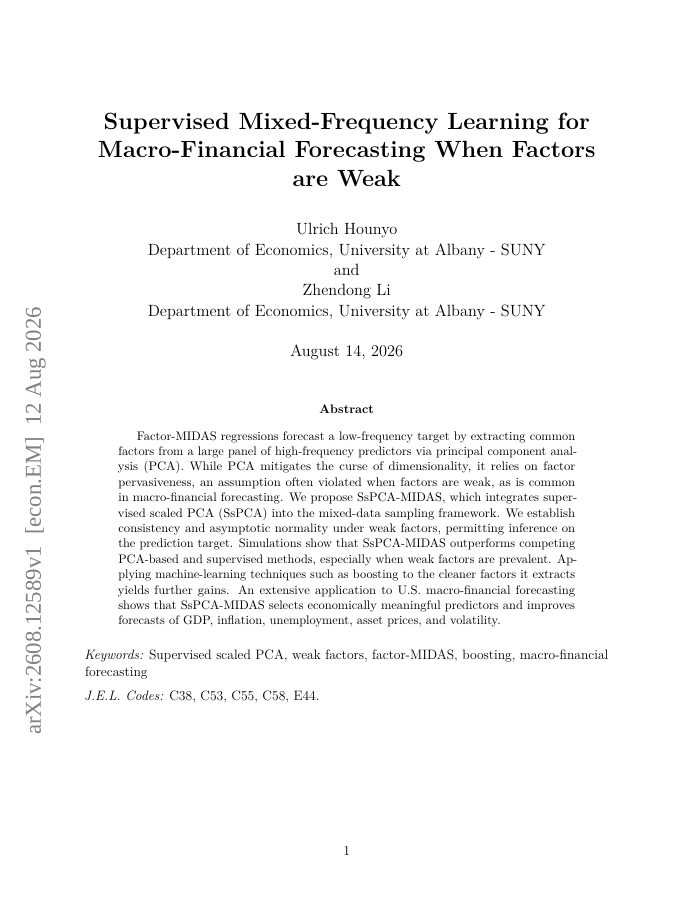
Factor-MIDAS regressions forecast a low-frequency target by extracting common factors from a large panel of high-frequency predictors via principal component analysis (PCA). While PCA mitigates the curse of dimensionality, it relies on factor pervasiveness, an assumption often violated when factors are weak, as is common in macro-financial forecasting. We propose SsPCA-MIDAS, which integrates supervised scaled PCA (SsPCA) into the mixed-data sampling framework. We establish consistency and asymptotic normality under weak factors, permitting inference on the prediction target. Simulations show that SsPCA-MIDAS outperforms competing PCA-based and supervised methods, especially when weak factors are prevalent. Applying machine-learning techniques such as boosting to the cleaner factors it extracts yields further gains. An extensive application to U.S. macro-financial forecasting shows that SsPCA-MIDAS selects economically meaningful predictors and improves forecasts of GDP, inflation, unemployment, asset prices, and volatility.
Supervised Mixed-Frequency Learning for Macro-Financial Forecasting When Factors are Weak
Factor-MIDAS regressions forecast a low-frequency target by extracting common factors from a large panel of high-frequency predictors via principal component analysis (PCA).
- Preview
- Year
- 2026
- Hosting
- Abstract onlyARXIV-DEFAULT
Cite
Notes
Only stored in your browser.
Attribution
- Abstract & full text
- arxiv.org/abs/2608.12589ARXIV-DEFAULT
- TL;DR
- Semantic Scholar