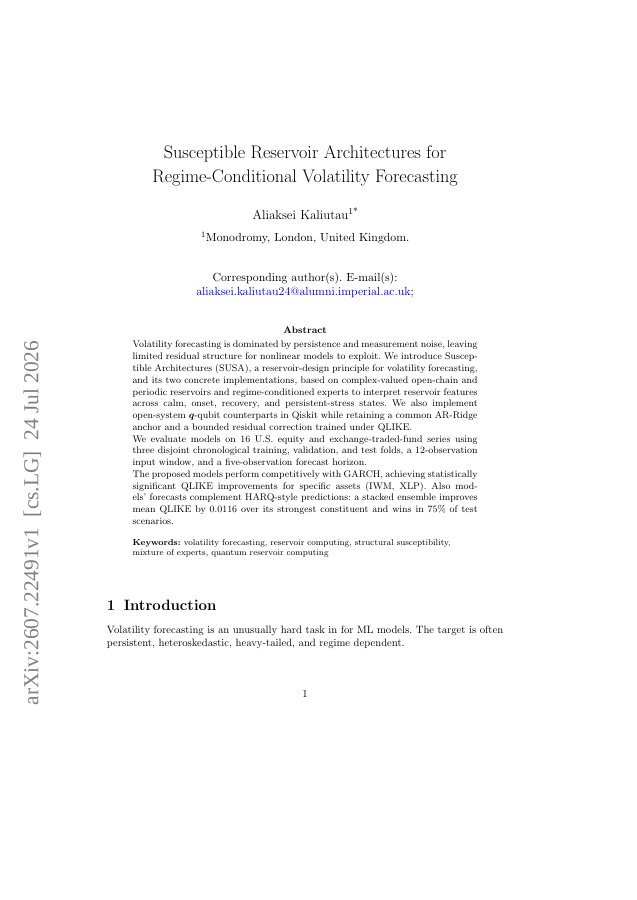
Volatility forecasting is dominated by persistence and measurement noise, leaving limited residual structure for nonlinear models to exploit. We introduce Susceptible Architectures (SUSA), a reservoir-design principle for volatility forecasting, and its two concrete implementations, based on complex-valued open-chain and periodic reservoirs and regime-conditioned experts to interpret reservoir features across calm, onset, recovery, and persistent-stress states. We also implement open-system q-qubit counterparts in Qiskit while retaining a common AR-Ridge anchor and a bounded residual correction trained under QLIKE. We evaluate models on 16 U.S. equity and exchange-traded-fund series using three disjoint chronological training, validation, and test folds, a 12-observation input window, and a five-observation forecast horizon. The proposed models perform competitively with GARCH, achieving statistically significant QLIKE improvements for specific assets (IWM, XLP). Also models' forecasts complement HARQ-style predictions: a stacked ensemble improves mean QLIKE by 0.0116 over its strongest constituent and wins in 75% of test scenarios.
Susceptible Reservoir Architectures for Regime-Conditional Volatility Forecasting
Volatility forecasting is dominated by persistence and measurement noise, leaving limited residual structure for nonlinear models to exploit. We introduce Susceptible Architectures (SUSA), a reservoir-design principle for volatility forecasting, and its two concrete…
- Preview
- Year
- 2026
- Hosting
- Excerpt onlyCC-BY-NC-SA-4.0
Cite
Notes
Only stored in your browser.
Attribution
- Abstract & full text
- arxiv.org/abs/2607.22491CC-BY-NC-SA-4.0
- TL;DR
- Semantic Scholar