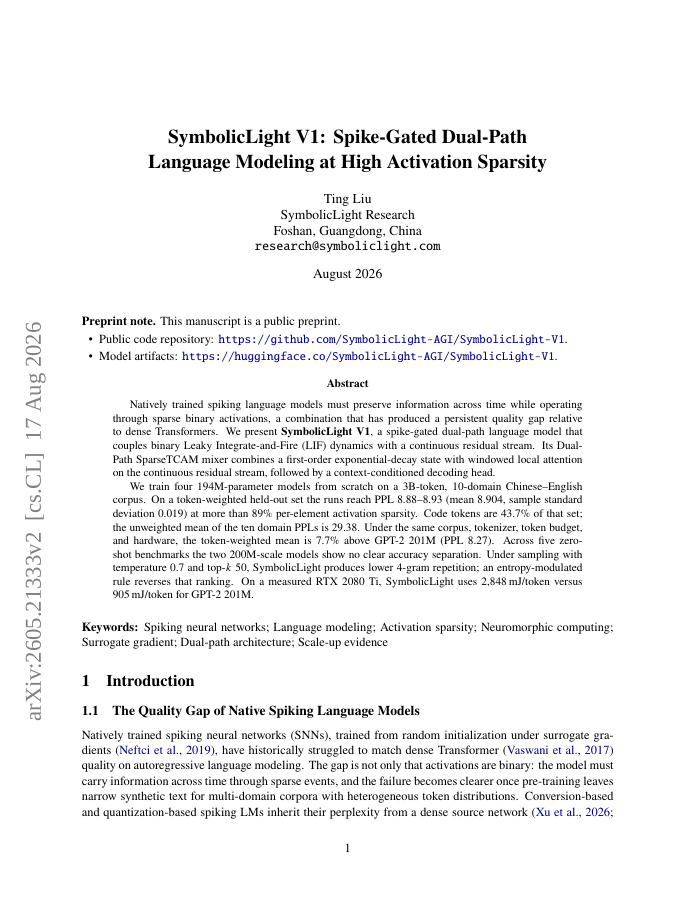
Natively trained spiking language models must preserve information across time while operating through sparse binary activations, a combination that has produced a persistent quality gap relative to dense Transformers. We present SymbolicLight V1, a spike-gated dual-path language model that couples binary Leaky Integrate-and-Fire (LIF) dynamics with a continuous residual stream. Its Dual-Path SparseTCAM mixer combines a first-order exponential-decay state with windowed local attention on the continuous residual stream, followed by a context-conditioned decoding head. We train four 194M-parameter models from scratch on a 3B-token, 10-domain Chinese-English corpus. On a token-weighted held-out set the runs reach PPL 8.88-8.93 (mean 8.904, sample standard deviation 0.019) at more than 89% per-element activation sparsity. Code tokens are 43.7% of that set; the unweighted mean of the ten domain PPLs is 29.38. Under the same corpus, tokenizer, token budget, and hardware, the token-weighted mean is 7.7% above GPT-2 201M (PPL 8.27). Across five zero-shot benchmarks the two 200M-scale models show no clear accuracy separation. Under sampling with temperature 0.7 and top-k 50, SymbolicLight produces lower 4-gram repetition; an entropy-modulated rule reverses that ranking. On a measured RTX 2080 Ti, SymbolicLight uses 2,848 mJ/token versus 905 mJ/token for GPT-2 201M.
SymbolicLight V1: Spike-Gated Dual-Path Language Modeling at High Activation Sparsity
Natively trained spiking language models must preserve information across time while operating through sparse binary activations, a combination that has produced a persistent quality gap relative to dense Transformers.
- Preview
- Year
- 2026
- Hosting
- Abstract onlyARXIV-DEFAULT
Cite
Notes
Only stored in your browser.
Attribution
- Abstract & full text
- arxiv.org/abs/2605.21333ARXIV-DEFAULT
- TL;DR
- Semantic Scholar