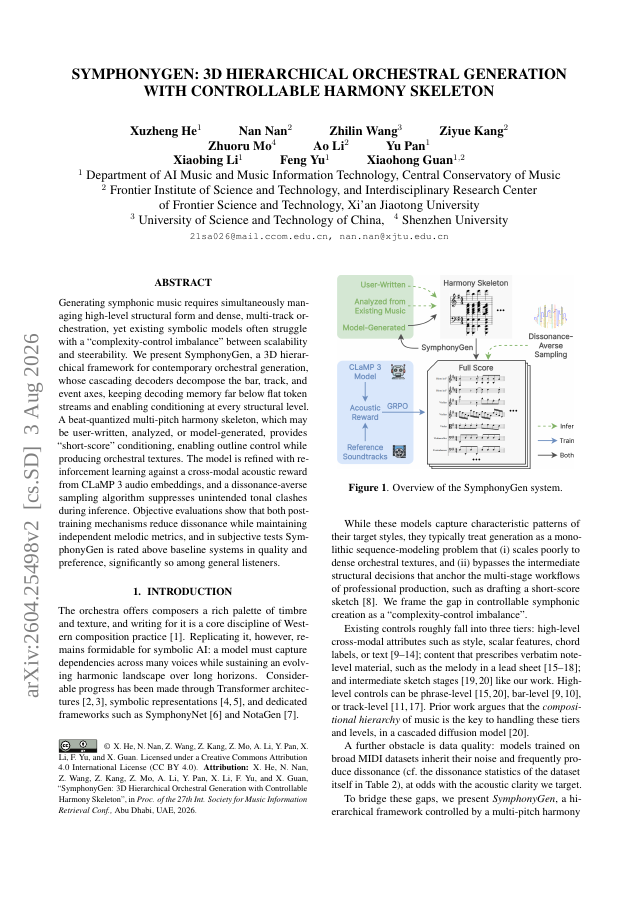
Generating symphonic music requires simultaneously managing high-level structural form and dense, multi-track orchestration, yet existing symbolic models often struggle with a "complexity-control imbalance" between scalability and steerability. We present SymphonyGen, a 3D hierarchical framework for contemporary orchestral generation, whose cascading decoders decompose the bar, track, and event axes, keeping decoding memory far below flat token streams and enabling conditioning at every structural level. A beat-quantized multi-pitch harmony skeleton, which may be user-written, analyzed, or model-generated, provides "short-score" conditioning, enabling outline control while producing orchestral textures. The model is refined with reinforcement learning against a cross-modal acoustic reward from CLaMP 3 audio embeddings, and a dissonance-averse sampling algorithm suppresses unintended tonal clashes during inference. Objective evaluations show that both post-training mechanisms reduce dissonance while maintaining independent melodic metrics, and in subjective tests SymphonyGen is rated above baseline systems in quality and preference, significantly so among general listeners.
SymphonyGen: 3D Hierarchical Orchestral Generation with Controllable Harmony Skeleton
Generating symphonic music requires simultaneously managing high-level structural form and dense, multi-track orchestration, yet existing symbolic models often struggle with a "complexity-control imbalance" between scalability and steerability.
- Preview
- Year
- 2026
- Hosting
- Full text hostedCC-BY-4.0
Cite
Notes
Only stored in your browser.
Attribution
- Abstract & full text
- arxiv.org/abs/2604.25498CC-BY-4.0
- TL;DR
- Semantic Scholar