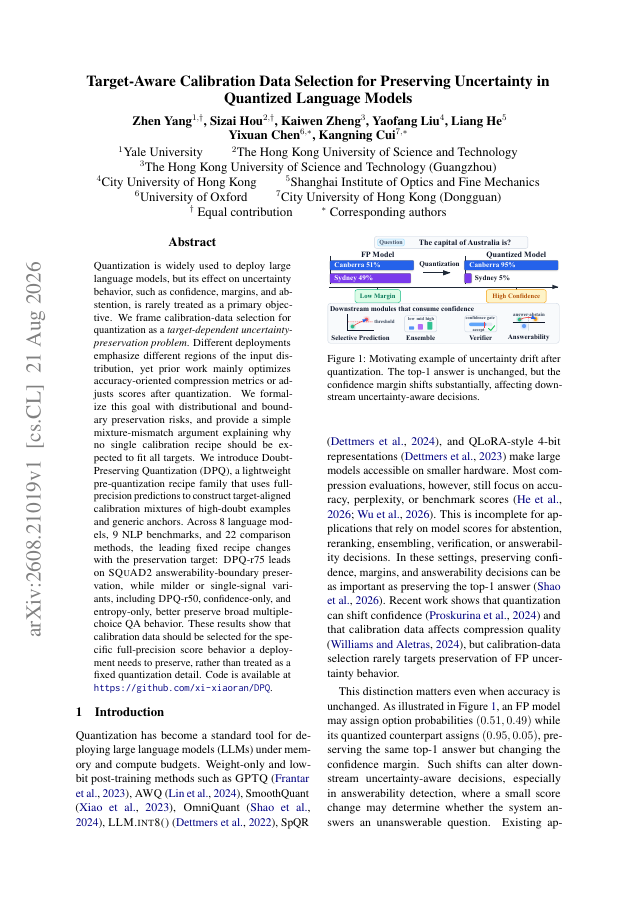
Quantization is widely used to deploy large language models, but its effect on uncertainty behavior, such as confidence, margins, and abstention, is rarely treated as a primary objective. We frame calibration-data selection for quantization as a target-dependent uncertainty-preservation problem. Different deployments emphasize different regions of the input distribution, yet prior work mainly optimizes accuracy-oriented compression metrics or adjusts scores after quantization. We formalize this goal with distributional and boundary preservation risks, and provide a simple mixture-mismatch argument explaining why no single calibration recipe should be expected to fit all targets. We introduce Doubt-Preserving Quantization (DPQ), a lightweight pre-quantization recipe family that uses full-precision predictions to construct target-aligned calibration mixtures of high-doubt examples and generic anchors. Across 8 language models, 9 NLP benchmarks, and 22 comparison methods, the leading fixed recipe changes with the preservation target: DPQ-r75 leads on SQuAD2 answerability-boundary preservation, while milder or single-signal variants, including DPQ-r50, confidence-only, and entropy-only, better preserve broad multiple-choice QA behavior. These results show that calibration data should be selected for the specific full-precision score behavior a deployment needs to preserve, rather than treated as a fixed quantization detail.
Target-Aware Calibration Data Selection for Preserving Uncertainty in Quantized Language Models
Quantization is widely used to deploy large language models, but its effect on uncertainty behavior, such as confidence, margins, and abstention, is rarely treated as a primary objective.
- Preview
- Year
- 2026
- Hosting
- Full text hostedCC-BY-4.0
Cite
Notes
Only stored in your browser.
Attribution
- Abstract & full text
- arxiv.org/abs/2608.21019CC-BY-4.0
- TL;DR
- Semantic Scholar