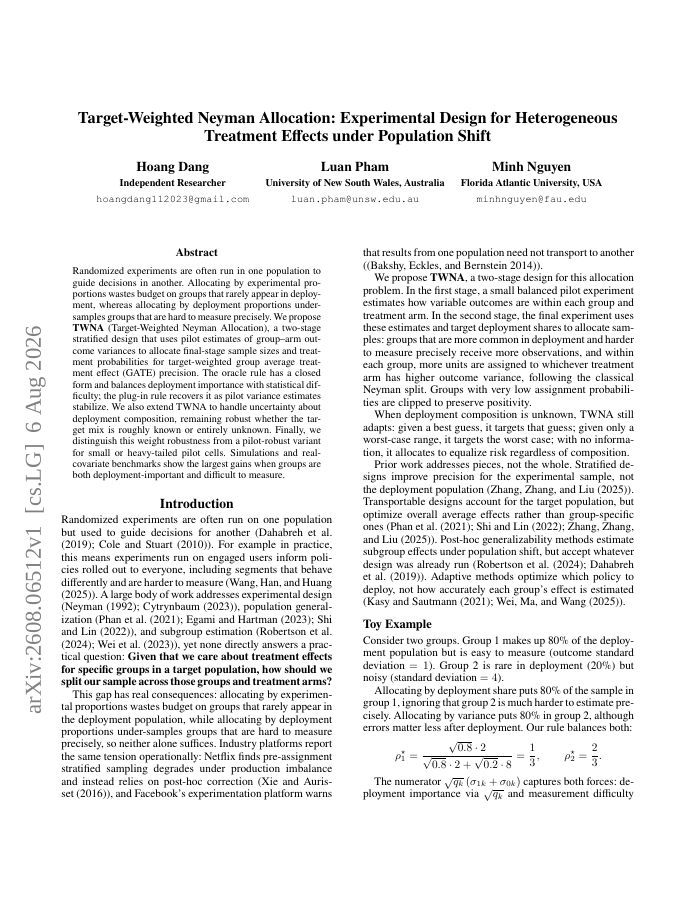
Randomized experiments are often run in one population to guide decisions in another. Allocating by experimental proportions wastes budget on groups that rarely appear in deployment, whereas allocating by deployment proportions under-samples groups that are hard to measure precisely. We propose TWNA (Target-Weighted Neyman Allocation), a two-stage stratified design that uses pilot estimates of group--arm outcome variances to allocate final-stage sample sizes and treatment probabilities for target-weighted group average treatment effect (GATE) precision. The oracle rule has a closed form and balances deployment importance with statistical difficulty; the plug-in rule recovers it as pilot variance estimates stabilize. We also extend TWNA to handle uncertainty about deployment composition, remaining robust whether the target mix is roughly known or entirely unknown. Finally, we distinguish this weight robustness from a pilot-robust variant for skewed, rare-event, or contaminated outcomes. Simulations and real-covariate benchmarks show the largest gains when groups are both deployment-important and difficult to measure.
Target-Weighted Neyman Allocation: Experimental Design for Heterogeneous Treatment Effects under Population Shift
Randomized experiments are often run in one population to guide decisions in another. Allocating by experimental proportions wastes budget on groups that rarely appear in deployment, whereas allocating by deployment proportions under-samples groups that are hard to measure…
- Preview
- Year
- 2026
- Hosting
- Abstract onlyARXIV-DEFAULT
Cite
Notes
Only stored in your browser.
Attribution
- Abstract & full text
- arxiv.org/abs/2608.06512ARXIV-DEFAULT
- TL;DR
- Semantic Scholar