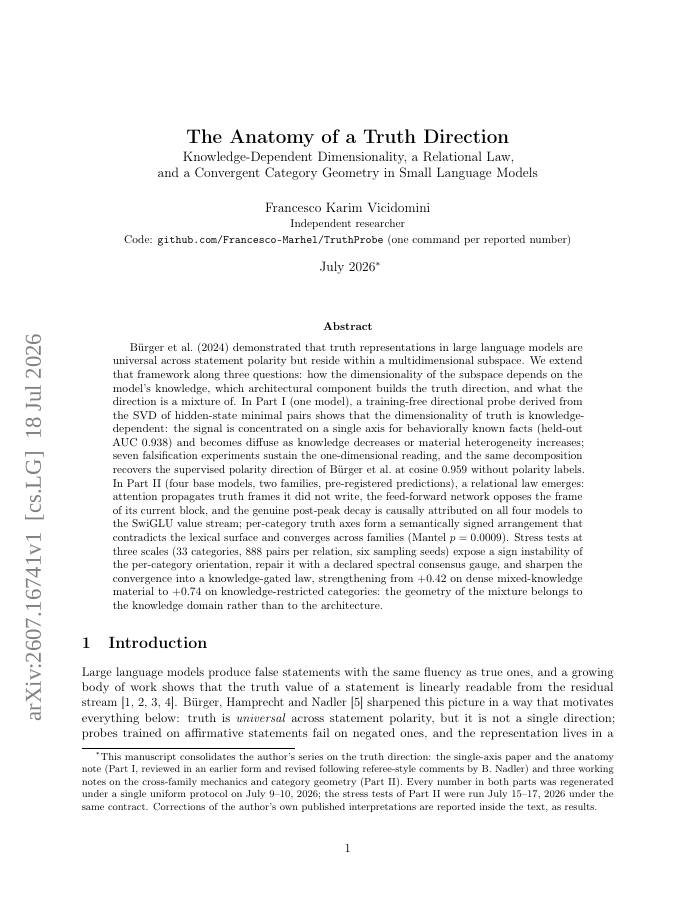
Bürger et al. (2024) demonstrated that truth representations in large language models are universal across statement polarity but reside within a multidimensional subspace. We extend this framework along three questions: how the dimensionality of the subspace depends on the model's knowledge, which architectural component builds the truth direction, and what the direction is a mixture of. In Part I, a training-free directional probe derived from the SVD of hidden-state minimal pairs shows that the dimensionality of truth is knowledge-dependent: the signal concentrates on a single axis for known facts and diffuses as knowledge decreases. In Part II, a relational law emerges across multiple model families: attention propagates truth frames, the feed-forward network opposes the current block's frame, and post-peak decay is causally attributed to the SwiGLU value stream. Furthermore, per-category truth axes form a semantically signed arrangement that converges across families. Stress tests expose a sign instability in this orientation, which we repair with a spectral consensus gauge to sharpen the convergence into a knowledge-gated law. Finally, a replication campaign on Gemma-2-2b, extending our decomposition tools to accommodate its sandwich normalization, confirms these laws and attributions. We quantify the knowledge gate as classical attenuation and isolate a stable, model-specific private geometry.
The Anatomy of a Truth Direction: Knowledge-Dependent Dimensionality, a Relational Law, and a Convergent Category Geometry in Small Language Models
Bürger et al. (2024) demonstrated that truth representations in large language models are universal across statement polarity but reside within a multidimensional subspace.
- Preview
- Year
- 2026
- Hosting
- Full text hostedCC-BY-4.0
Cite
Notes
Only stored in your browser.
Attribution
- Abstract & full text
- arxiv.org/abs/2607.16741CC-BY-4.0
- TL;DR
- Semantic Scholar