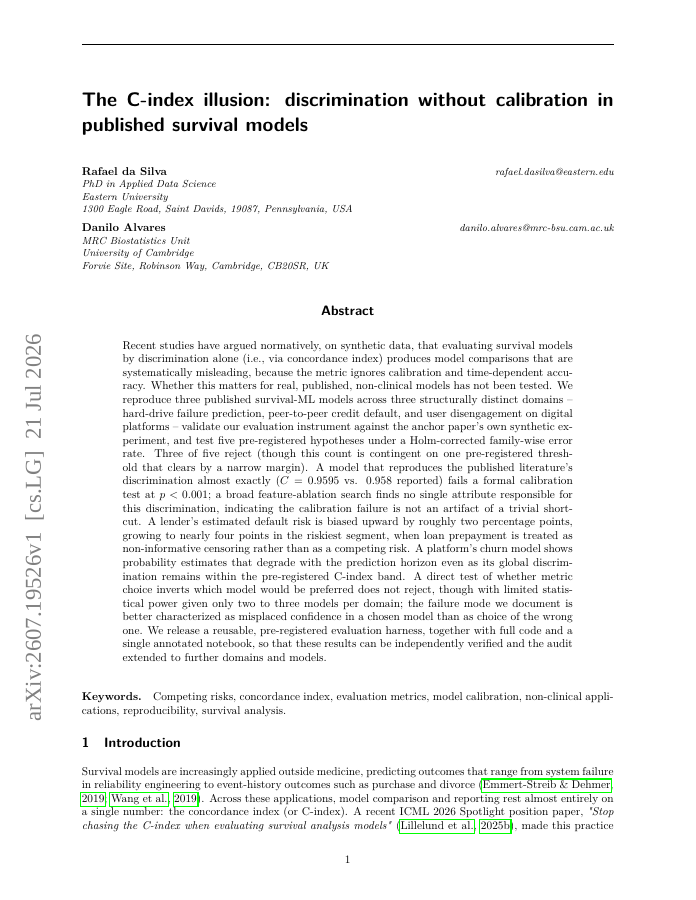
Recent work has argued normatively, on synthetic data, that evaluating survival models by discrimination alone (concordance index) yields systematically misleading model comparisons, because the metric ignores calibration and time-dependent accuracy. Whether this matters for real, published, non-clinical models has not been tested. We reproduce three published survival-ML models across three structurally distinct domains -- hard-drive failure prediction, peer-to-peer credit default, and user disengagement on digital platforms -- validate our instrument against the anchor paper's own synthetic experiment, and test five pre-registered hypotheses under a Holm-corrected family-wise error rate. Three of five reject (though one pre-registered threshold clears by a narrow margin). A model reproducing the published literature's discrimination almost exactly (C = 0.9595 vs. 0.958 reported) fails a formal calibration test at p < 0.001; a broad feature-ablation search finds no single attribute responsible for its discrimination, so the calibration failure is not a trivial shortcut artifact. A lender's estimated default risk is biased upward by roughly two percentage points, growing to nearly four in the riskiest segment, when loan prepayment is treated as non-informative censoring rather than a competing risk. A platform's churn model shows probability estimates that degrade with the horizon even as global discrimination stays within the pre-registered C-index band. A direct test of whether metric choice inverts model preference does not reject, though with limited power given two to three models per domain; the failure mode we document is better characterized as misplaced confidence in a chosen model than as choosing the wrong one. We release a pre-registered evaluation harness with full code and an annotated notebook, so these results can be verified independently and the audit extended.
The C-index illusion: discrimination without calibration in published survival models
Recent work has argued normatively, on synthetic data, that evaluating survival models by discrimination alone (concordance index) yields systematically misleading model comparisons, because the metric ignores calibration and time-dependent accuracy.
- Preview
- Year
- 2026
- Hosting
- Abstract onlyARXIV-DEFAULT
Cite
Notes
Only stored in your browser.
Attribution
- Abstract & full text
- arxiv.org/abs/2607.19526ARXIV-DEFAULT
- TL;DR
- Semantic Scholar