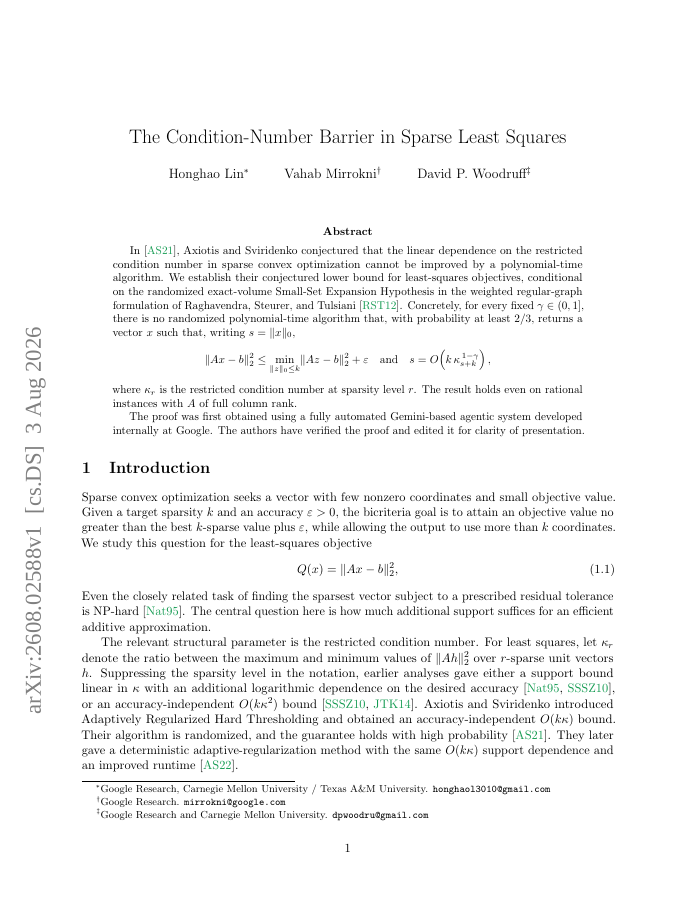
In [AS21], Axiotis and Sviridenko conjectured that the linear dependence on the restricted condition number in sparse convex optimization cannot be improved by a polynomial-time algorithm. We establish their conjectured lower bound for least-squares objectives, conditional on the randomized exact-volume Small-Set Expansion Hypothesis in the weighted regular-graph formulation of Raghavendra, Steurer, and Tulsiani [RST12]. Concretely, for every fixed γ\in(0,1], there is no randomized polynomial-time algorithm that, with probability at least 2/3, returns a vector x such that, writing s=\lVert x\rVert_0, [ \lVert Ax-b\rVert_2^2 \leq \min_{\lVert z\rVert_0\leq k}\lVert Az-b\rVert_2^2+\varepsilon \quadand\quad s=O!\left(k,κ_{s+k}^{,1-γ}\right), ] where κ_r is the restricted condition number at sparsity level r. The result holds even on rational instances with A of full column rank. The proof was first obtained using a fully automated Gemini-based agentic system developed internally at Google. The authors have verified the proof and edited it for clarity of presentation.
The Condition-Number Barrier in Sparse Least Squares
In [AS21], Axiotis and Sviridenko conjectured that the linear dependence on the restricted condition number in sparse convex optimization cannot be improved by a polynomial-time algorithm.
- Preview
- Year
- 2026
- Hosting
- Abstract onlyARXIV-DEFAULT
Cite
Notes
Only stored in your browser.
Attribution
- Abstract & full text
- arxiv.org/abs/2608.02588ARXIV-DEFAULT
- TL;DR
- Semantic Scholar