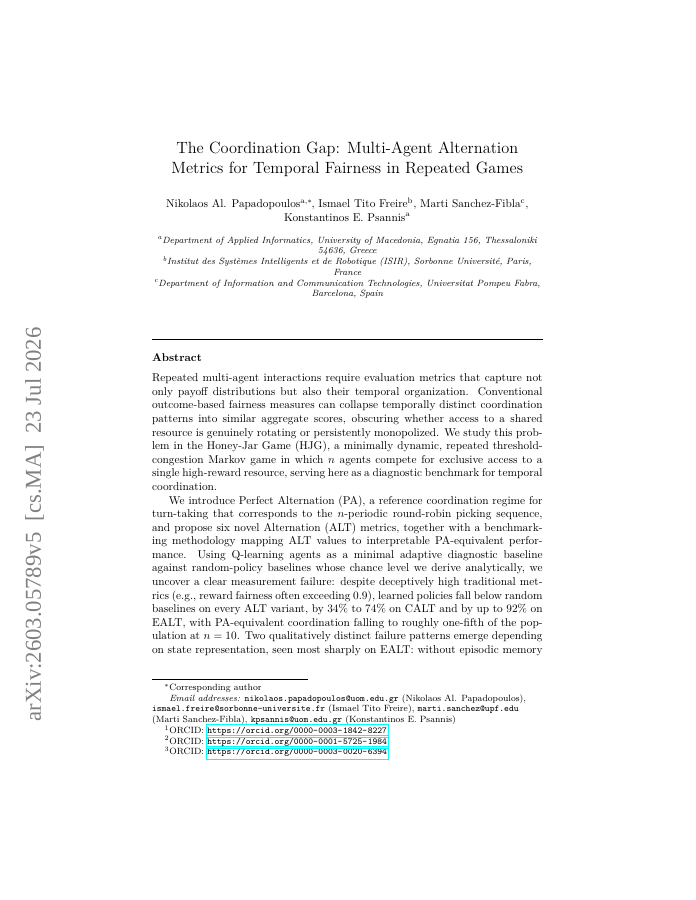
Repeated multi-agent interactions require evaluation metrics that capture not only payoff distributions but also their temporal organization. Conventional outcome-based fairness measures can assign similar aggregate scores to temporally distinct coordination patterns, obscuring whether access to a shared resource is genuinely rotating or persistently monopolized. We study this problem in the Honey-Jar Game (HJG), a minimally dynamic repeated threshold-congestion Markov game in which n agents compete for exclusive access to a single high-reward resource. We introduce Perfect Alternation (PA), a reference turn-taking regime corresponding to the n-periodic round-robin picking sequence, together with six novel Alternation (ALT) metrics and a benchmarking methodology mapping ALT values to interpretable PA-equivalent performance. Using Q-learning agents as a minimal adaptive baseline against analytically derived random-policy baselines, we uncover a clear measurement failure: despite deceptively high traditional metrics (e.g., reward fairness often exceeding 0.9), learned policies perform worse than random on every ALT metric, by 34-74% on CALT and up to 92% on EALT, with PA-equivalent coordination falling to roughly one-fifth of the population at n=10. EALT further reveals two distinct failure patterns: without episodic memory (Type-A), the deficit grows from -20% at n=2 to -92% at n=10; with episodic memory (Type-B), it reaches a trough of -76% at n=5 before partially recovering to -10% at n=10. Conventional efficiency and fairness metrics do not reveal these differences. The ALT framework complements the temporal fair division and picking-sequence literature by diagnosing whether temporal fairness emerges spontaneously in decentralized adaptive systems rather than how to enforce it.
The Coordination Gap: Multi-Agent Alternation Metrics for Temporal Fairness in Repeated Games
Repeated multi-agent interactions require evaluation metrics that capture not only payoff distributions but also their temporal organization. Conventional outcome-based fairness measures can assign similar aggregate scores to temporally distinct coordination patterns, obscuring…
- Preview
- Year
- 2026
- Hosting
- Abstract onlyARXIV-DEFAULT
Cite
Notes
Only stored in your browser.
Attribution
- Abstract & full text
- arxiv.org/abs/2603.05789ARXIV-DEFAULT
- TL;DR
- Semantic Scholar