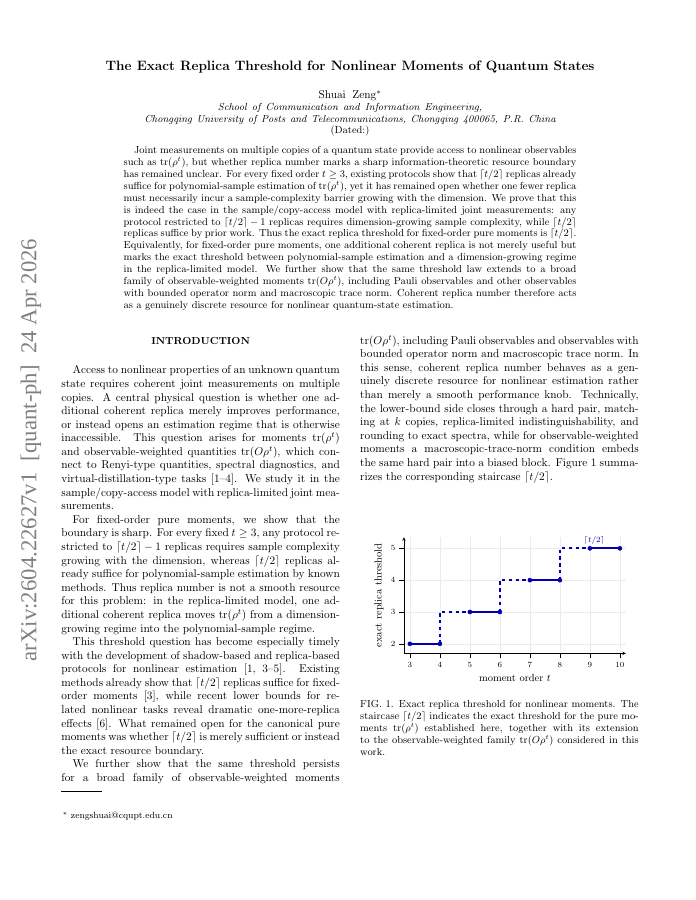
Joint measurements on multiple copies of a quantum state provide access to nonlinear observables such as \operatorname{tr}(ρ^t), but whether replica number marks a sharp information-theoretic resource boundary has remained unclear. For every fixed order t\ge 3, existing protocols show that \lceil t/2\rceil replicas already suffice for polynomial-sample estimation of \operatorname{tr}(ρ^t), yet it has remained open whether one fewer replica must necessarily incur a sample-complexity barrier growing with the dimension. We prove that this is indeed the case in the sample/copy-access model with replica-limited joint measurements: any protocol restricted to \lceil t/2\rceil-1 replicas requires dimension-growing sample complexity, while \lceil t/2\rceil replicas suffice by prior work. Thus the exact replica threshold for fixed-order pure moments is \lceil t/2\rceil. Equivalently, for fixed-order pure moments, one additional coherent replica is not merely useful but marks the exact threshold between polynomial-sample estimation and a dimension-growing regime in the replica-limited model. We further show that the same threshold law extends to a broad family of observable-weighted moments \operatorname{tr}(Oρ^t), including Pauli observables and other observables with bounded operator norm and macroscopic trace norm. Coherent replica number therefore acts as a genuinely discrete resource for nonlinear quantum-state estimation.
The Exact Replica Threshold for Nonlinear Moments of Quantum States
Joint measurements on multiple copies of a quantum state provide access to nonlinear observables such as $\operatorname{tr}(ρ^t)$, but whether replica number marks a sharp information-theoretic resource boundary has remained unclear.
- Preview
- Year
- 2026
- Hosting
- Abstract onlyARXIV-DEFAULT
Cite
Notes
Only stored in your browser.
Attribution
- Abstract & full text
- arxiv.org/abs/2604.22627ARXIV-DEFAULT
- TL;DR
- Semantic Scholar