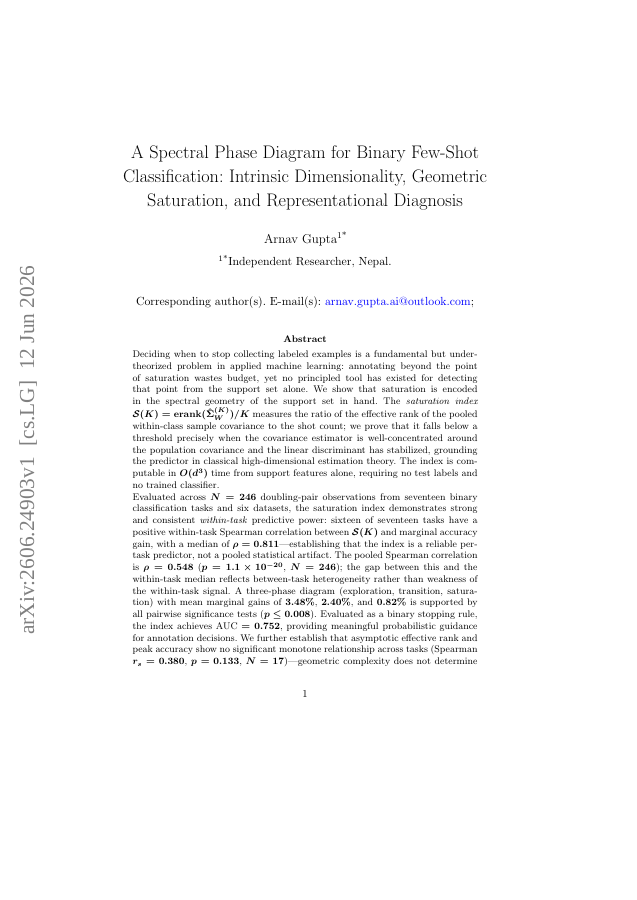
Few-shot label acquisition lacks a label-free signal for when additional labels cease to improve accuracy: existing stopping criteria either require a held-out validation set (violating the few-shot premise) or rely on theoretically ungrounded heuristics, so we introduce the spectral saturation index S(K)=erank(\hatΣ_W^{(K)})/K, the exponential spectral entropy of the pooled within-class covariance normalized by per-class support size K, which measures the exploration rate per label and falls below a fixed threshold τ=0.02 once the explored spectral subspace saturates and marginal accuracy gains vanish; across 49 real tasks (binary, 5-way, 10-way) and three frozen backbones (PCA-50, CLIP ViT-B/32, DINOv2 ViT-S/14), S(K) correlates strongly with the marginal gain on doubling the support set (ρ_{pool}=0.6366, p=2.9\times10^{-57}, cluster-bootstrap 95% CI [0.551,0.720]), a fixed τ=0.02 classifies stop/continue decisions with cluster-bootstrap AUC=0.787 (95% CI [0.713,0.860]) with high recall on meaningful gains (ΔA>1%), and a partial correlation controlling for \log K yields ρ_{partial}=0.324 (p=1.65\times10^{-13}), confirming S(K) carries spectral information beyond shared K-dependence; theory predicts this from first principles, since the population effective rank sets the saturation scale K_{sat}\approxerank(Σ_W)/τ, τ=0.02 sits at the boundary between the first and second descent (Nakkiran et al., 2021), and O(1/K) bias in the sample effective rank explains the small-K hump in S(K); for unregularized linear probes (C=\infty), practitioners should halt when S(K)<0.02 (PCA-50, hard stop) or monitor S(K) dropping from \sim0.3\to0.05 (foundation models, diminishing-returns signal), with computation costing \sim1 ms at d=50.
The Geometry of Saturation: Effective Rank Predicts When Labels Stop Helping in Few-Shot Classification
Few-shot label acquisition lacks a label-free signal for when additional labels cease to improve accuracy: existing stopping criteria either require a held-out validation set (violating the few-shot premise) or rely on theoretically ungrounded heuristics, so we introduce the…
- Preview
- Year
- 2026
- Hosting
- Abstract onlyARXIV-DEFAULT
Cite
Notes
Only stored in your browser.
Attribution
- Abstract & full text
- arxiv.org/abs/2606.24903ARXIV-DEFAULT
- TL;DR
- Semantic Scholar