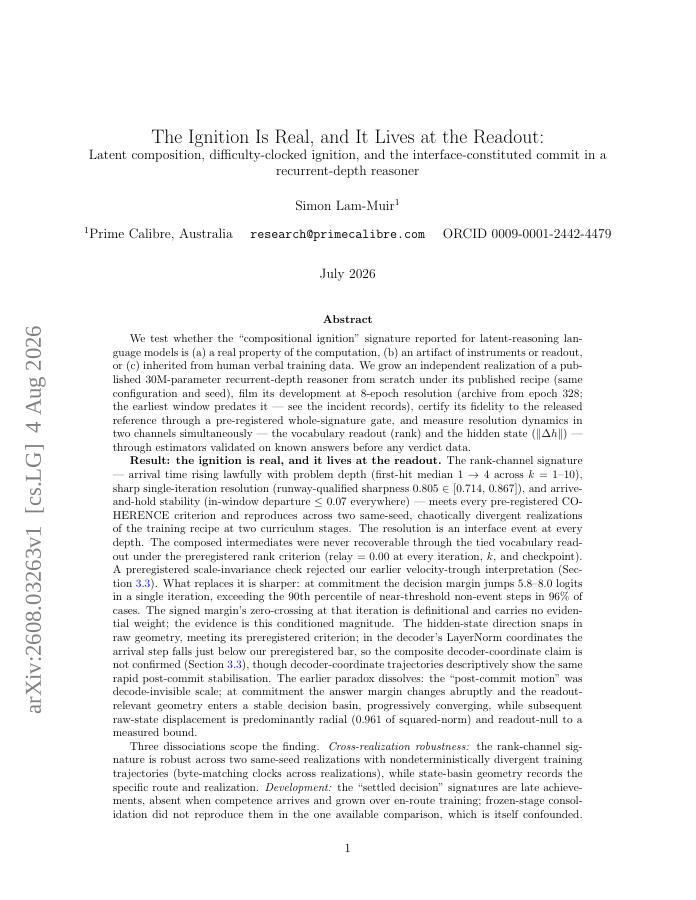
We test whether the "compositional ignition" reported in latent-reasoning models is real computation, an instrument artifact, or inherited from verbal training data. We grow an independent realization of a published 30M-parameter recurrent-depth reasoner from scratch (same recipe and seed), film its development, certify fidelity through a pre-registered whole-signature gate, and measure resolution in two channels at once: the vocabulary readout and the hidden state. The ignition is real and lives at the readout: arrival time rises lawfully with problem depth, resolution is sharp and holds, and the signature reproduces across two same-seed realizations with divergent training trajectories. At commitment the decision margin jumps 5.8-8.0 logits in one iteration, exceeding the 90th percentile of near-threshold non-event steps in 96% of cases; the signed margin's zero-crossing there is definitional and carries no evidential weight, so the evidence is that conditioned magnitude. The hidden-state direction snaps in raw geometry, meeting its pre-registered criterion (in the decoder's LayerNorm coordinates it attenuates just below our bar, so the composite decoder-coordinate claim is not confirmed), and then freezes in both (descriptively so in decoder coordinates; angular steps 52.9 to 1.2 degrees over eight iterations), while subsequent displacement is predominantly radial (0.961 of squared-norm) and readout-null to a measured bound (radial logit effect <=5.7e-6). An earlier velocity-trough claim is withdrawn: pre-registered normalization controls showed it coordinate-dependent. Intermediates were never recoverable through the tied readout (relay 0.00). All criteria were frozen before their data; the predictions ledger, including this paper's own withdrawn headline, ships in the companion repository.
The Ignition Is Real, and It Lives at the Readout: Latent composition, difficulty-clocked ignition, and the interface-constituted commit in a recurrent-depth reasoner
We test whether the "compositional ignition" reported in latent-reasoning models is real computation, an instrument artifact, or inherited from verbal training data.
- Preview
- Year
- 2026
- Hosting
- Full text hostedCC-BY-4.0
Cite
Notes
Only stored in your browser.
Attribution
- Abstract & full text
- arxiv.org/abs/2608.03263CC-BY-4.0
- TL;DR
- Semantic Scholar