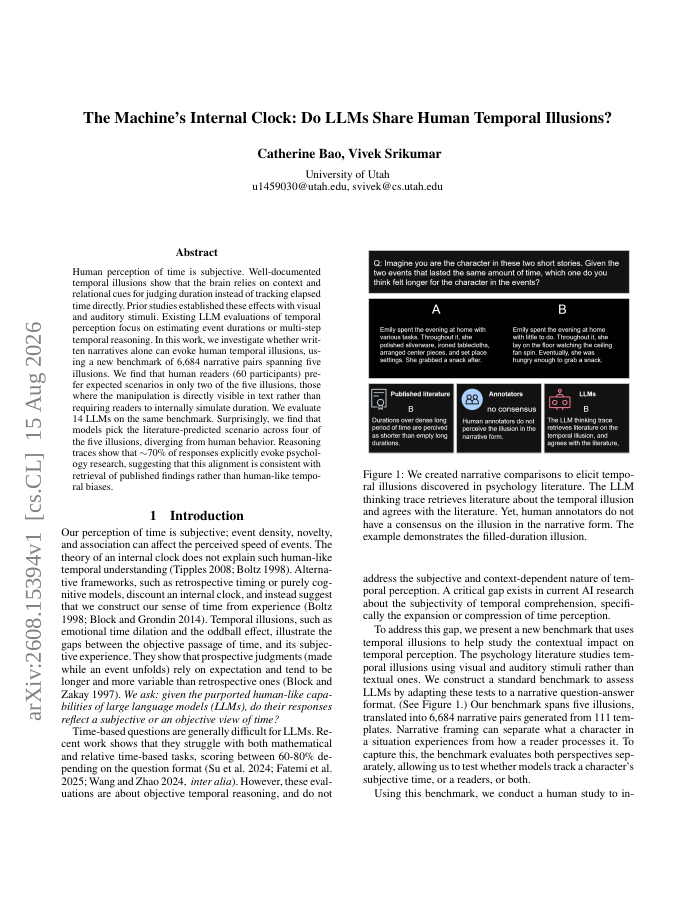
Human perception of time is subjective. Well-documented temporal illusions show that the brain relies on context and relational cues for judging duration instead of tracking elapsed time directly. Prior studies established these effects with visual and auditory stimuli. Existing LLM evaluations of temporal perception focus on estimating event durations or multi-step temporal reasoning. In this work, we investigate whether written narratives alone can evoke human temporal illusions, using a new benchmark of 6,684 narrative pairs spanning five illusions. We find that human readers (60 participants) prefer expected scenarios in only two of the five illusions, those where the manipulation is directly visible in text rather than requiring readers to internally simulate duration. We evaluate 14 LLMs on the same benchmark. Surprisingly, we find that models pick the literature-predicted scenario across four of the five illusions, diverging from human behavior. Reasoning traces show that 70% of responses explicitly evoke psychology research, suggesting that this alignment is consistent with retrieval of published findings rather than human-like temporal biases.
The Machine's Internal Clock: Do LLMs Share Human Temporal Illusions?
Human perception of time is subjective. Well-documented temporal illusions show that the brain relies on context and relational cues for judging duration instead of tracking elapsed time directly. Prior studies established these effects with visual and auditory stimuli.
- Preview
- Year
- 2026
- Hosting
- Full text hostedCC-BY-4.0
Cite
Notes
Only stored in your browser.
Attribution
- Abstract & full text
- arxiv.org/abs/2608.15394CC-BY-4.0
- TL;DR
- Semantic Scholar