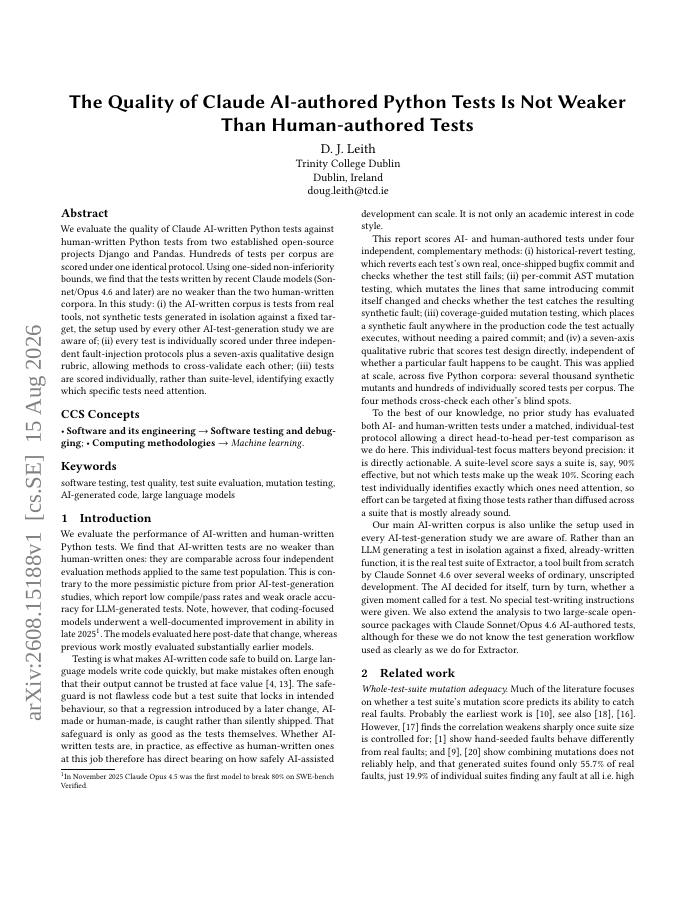
We evaluate the quality of Claude AI-written Python tests against human-written Python tests from two established open-source projects Django and Pandas. Hundreds of tests per corpus are scored under one identical protocol. Using one-sided non-inferiority bounds, we find that the tests written by recent Claude models (Sonnet/Opus 4.6 and later) are no weaker than the two human-written corpora. In this study: (i) the AI-written corpus is tests from real tools, not synthetic tests generated in isolation against a fixed target, the setup used by every other AI-test-generation study we are aware of; (ii) every test is individually scored under three independent fault-injection protocols plus a seven-axis qualitative design rubric, allowing methods to cross-validate each other; (iii) tests are scored individually, rather than suite-level, identifying exactly which specific tests need attention.
The Quality of Claude AI-authored Python Tests Is Not Weaker Than Human-authored Tests
We evaluate the quality of Claude AI-written Python tests against human-written Python tests from two established open-source projects Django and Pandas. Hundreds of tests per corpus are scored under one identical protocol.
- Preview
- Year
- 2026
- Hosting
- Full text hostedCC-BY-4.0
Cite
Notes
Only stored in your browser.
Attribution
- Abstract & full text
- arxiv.org/abs/2608.15188CC-BY-4.0
- TL;DR
- Semantic Scholar