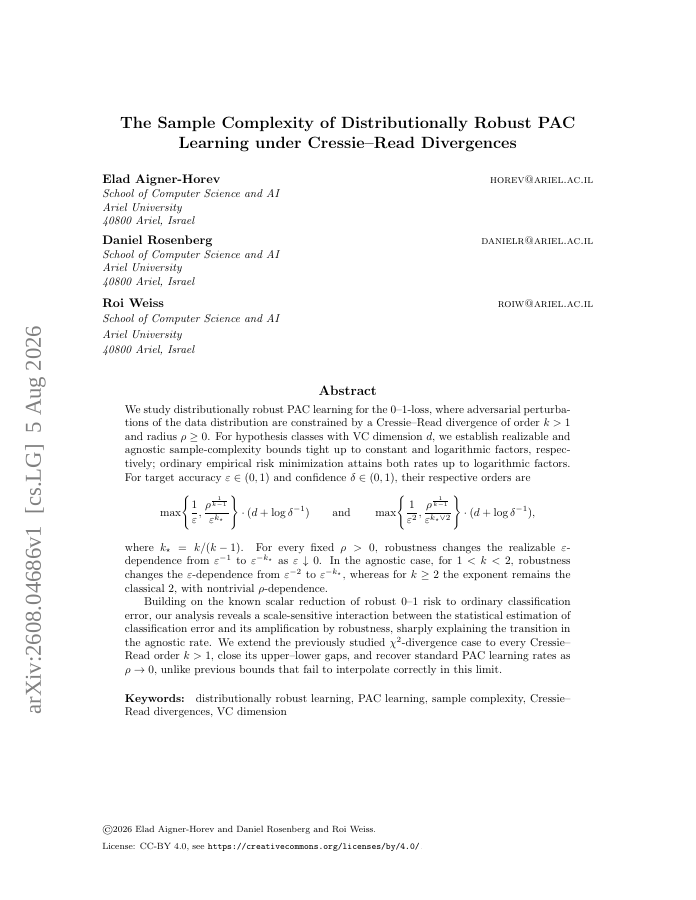
We study distributionally robust PAC learning for the 0--1-loss, where adversarial perturbations of the data distribution are constrained by a Cressie--Read divergence of order k>1 and radius ρ\geq 0. For hypothesis classes with VC dimension d, we establish realizable and agnostic sample-complexity bounds tight up to constant and logarithmic factors, respectively; ordinary empirical risk minimization attains both rates up to logarithmic factors. For target accuracy \varepsilon\in(0,1) and confidence δ\in(0,1), their respective orders are [ \max!\left{\frac{1}{\varepsilon}, \frac{ρ^{\frac 1{k-1}}}{\varepsilon^{k_\star}} \right}\cdot(d+\log δ^{-1}) \qquadand\qquad \max!\left{\frac{1}{\varepsilon^2}, \frac{ρ^{\frac1{k-1}}}{\varepsilon^{k_\star\vee 2}} \right}\cdot(d+\log δ^{-1}), ] where k_\star={k}/{(k-1)}. For every fixed ρ>0, robustness changes the realizable \varepsilon-dependence from \varepsilon^{-1} to \varepsilon^{-k_\star} as \varepsilon\downarrow0. In the agnostic case, for 1<k<2, robustness changes the \varepsilon-dependence from \varepsilon^{-2} to \varepsilon^{-k_\star}, whereas for k\geq2 the exponent remains the classical 2, with nontrivial ρ-dependence. Building on the known scalar reduction of robust 0--1 risk to ordinary classification error, our analysis reveals a scale-sensitive interaction between the statistical estimation of classification error and its amplification by robustness, sharply explaining the transition in the agnostic rate. We extend the previously studied χ^2-divergence case to every Cressie--Read order k>1, close its upper--lower gaps, and recover standard PAC learning rates as ρ\to0, unlike previous bounds that fail to interpolate correctly in this limit.
The Sample Complexity of Distributionally Robust PAC Learning under Cressie--Read Divergences
We study distributionally robust PAC learning for the $0$--$1$-loss, where adversarial perturbations of the data distribution are constrained by a Cressie--Read divergence of order $k>1$ and radius $ρ\geq 0$.
- Preview
- Year
- 2026
- Hosting
- Abstract onlyARXIV-DEFAULT
Cite
Notes
Only stored in your browser.
Attribution
- Abstract & full text
- arxiv.org/abs/2608.04686ARXIV-DEFAULT
- TL;DR
- Semantic Scholar