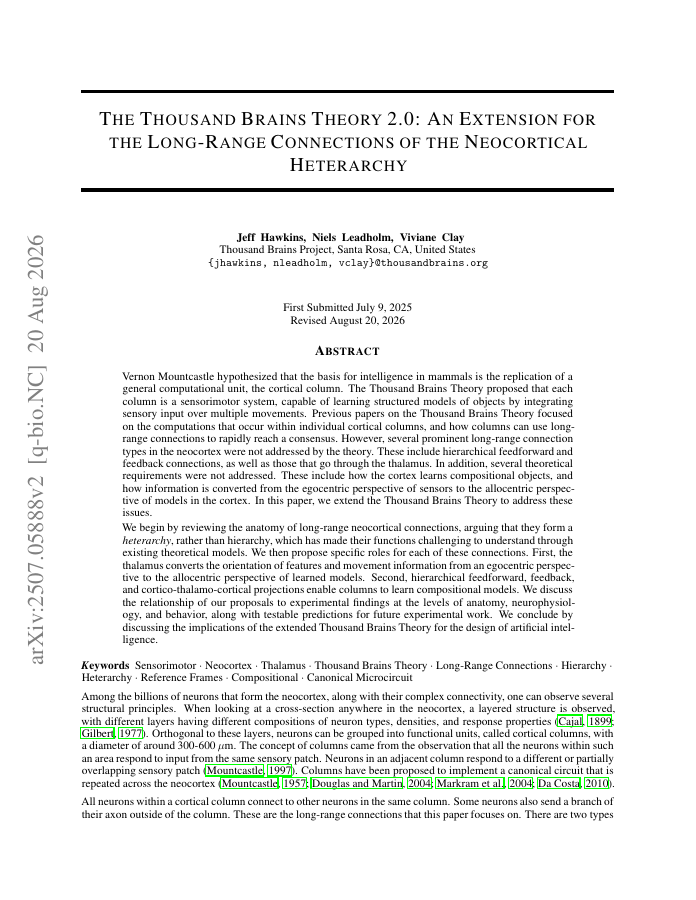
Vernon Mountcastle hypothesized that the basis for intelligence in mammals is the replication of a general computational unit, the cortical column. The Thousand Brains Theory proposed that each column is a sensorimotor system, capable of learning structured models of objects by integrating sensory input over multiple movements. Previous papers on the Thousand Brains Theory focused on the computations that occur within individual cortical columns, and how columns can use long-range connections to rapidly reach a consensus. However, several prominent long-range connection types in the neocortex were not addressed by the theory. These include hierarchical feedforward and feedback connections, as well as those that go through the thalamus. In addition, several theoretical requirements were not addressed. These include how the cortex learns compositional objects, and how information is converted from the egocentric perspective of sensors to the allocentric perspective of models in the cortex. In this paper, we extend the Thousand Brains Theory to address these issues. We begin by reviewing the anatomy of long-range neocortical connections, arguing that they form a heterarchy, rather than hierarchy, which has made their functions challenging to understand through existing theoretical models. We then propose specific roles for each of these connections. First, the thalamus converts the orientation of features and movement information from an egocentric perspective to the allocentric perspective of learned models. Second, hierarchical feedforward, feedback, and cortico-thalamo-cortical projections enable columns to learn compositional models. We discuss the relationship of our proposals to experimental findings at the levels of anatomy, neurophysiology, and behavior, along with testable predictions for future experimental work.
The Thousand Brains Theory 2.0: An Extension for the Long-Range Connections of the Neocortical Heterarchy
Vernon Mountcastle hypothesized that the basis for intelligence in mammals is the replication of a general computational unit, the cortical column. The Thousand Brains Theory proposed that each column is a sensorimotor system, capable of learning structured models of objects by…
- Preview
- Year
- 2025
- Hosting
- Full text hostedCC-BY-4.0
Cite
Notes
Only stored in your browser.
Attribution
- Abstract & full text
- arxiv.org/abs/2507.05888CC-BY-4.0
- TL;DR
- Semantic Scholar