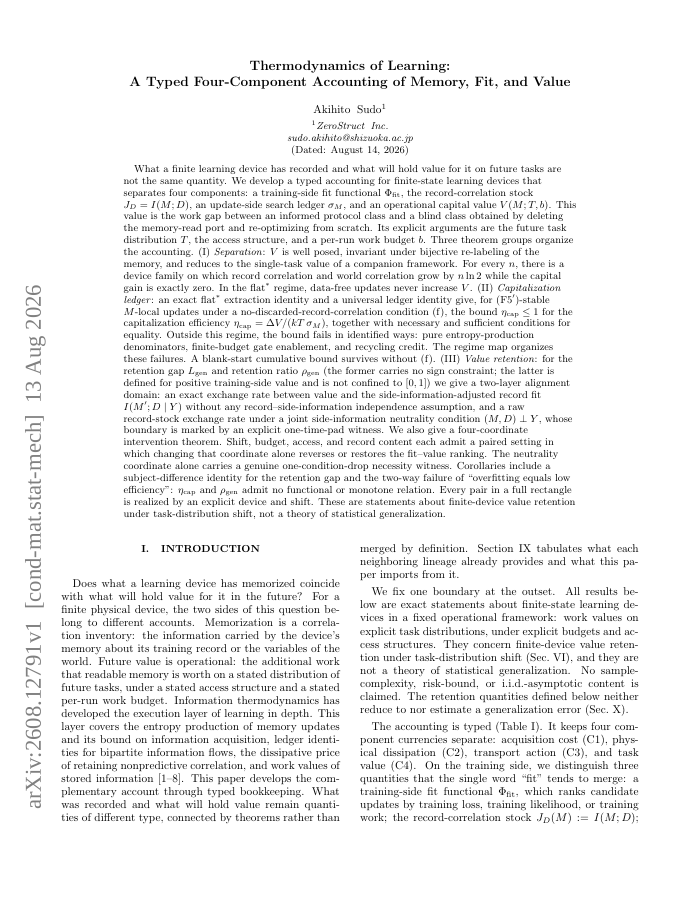
What a finite learning device has recorded and what will hold value for it on future tasks are not the same quantity. We develop a typed accounting for finite-state learning devices that separates four components: a training-side fit functional Φ_{fit}, the record-correlation stock J_{D}=I(M;D), an update-side search ledger σ_{M}, and an operational capital value V(M;T,b). This value is the work gap between an informed protocol class and a blind class obtained by deleting the memory-read port and re-optimizing from scratch. (I) Separation: for every n, there is a device family on which record correlation and world correlation grow by n\ln 2 while the capital gain is exactly zero. In the flat^{} regime, data-free updates never increase V. (II) Capitalization ledger: an exact flat^{} extraction identity and a universal ledger identity give, for (F5')-stable M-local updates under a no-discarded-record-correlation condition (f), the bound η_{cap}\le 1 for the capitalization efficiency η_{cap}=ΔV/(k T,σ_{M}), together with necessary and sufficient conditions for equality. (III) Value retention: for the retention gap L_{gen} and retention ratio ρ_{gen} (the former carries no sign constraint; the latter is defined for positive training-side value and is not confined to [0,1]) we give a two-layer alignment domain: an exact exchange rate between value and the side-information-adjusted record fit I(M';D\mid Y) without any record-side-information independence assumption, and a raw record-stock exchange rate under a joint side-information neutrality condition (M,D)\perp Y, whose boundary is marked by an explicit one-time-pad witness. These are statements about finite-device value retention under task-distribution shift, not a theory of statistical generalization.
Thermodynamics of Learning: A Typed Four-Component Accounting of Memory, Fit, and Value
What a finite learning device has recorded and what will hold value for it on future tasks are not the same quantity. We develop a typed accounting for finite-state learning devices that separates four components: a training-side fit functional $Φ_{\mathrm{fit}}$, the…
- Preview
- Year
- 2026
- Hosting
- Abstract onlyARXIV-DEFAULT
Cite
Notes
Only stored in your browser.
Attribution
- Abstract & full text
- arxiv.org/abs/2608.12791ARXIV-DEFAULT
- TL;DR
- Semantic Scholar