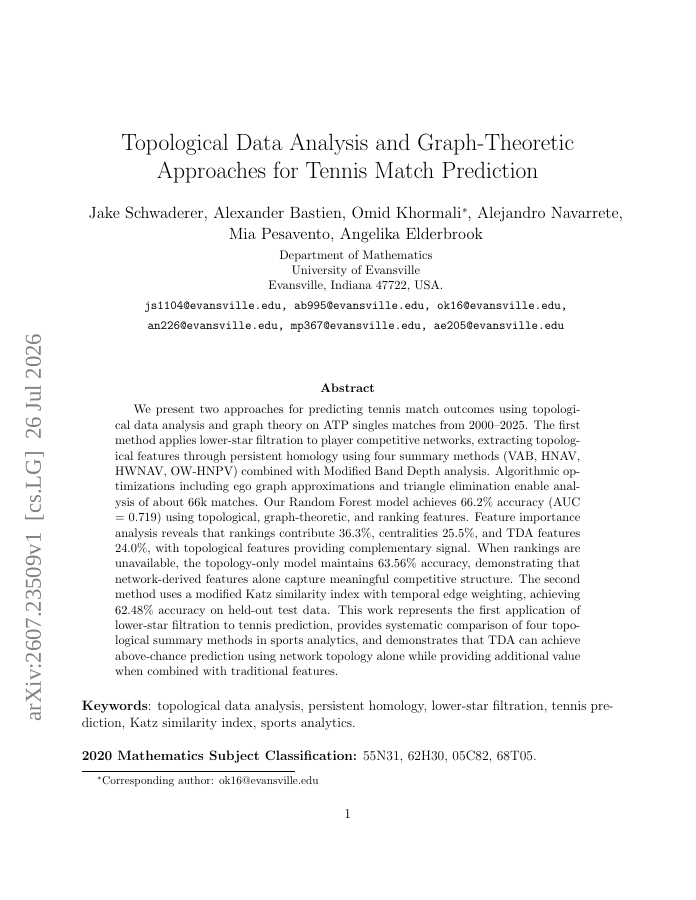
We present two approaches for predicting tennis match outcomes using topological data analysis and graph theory on ATP singles matches from 2000-2025. The first method applies lower-star filtration to player competitive networks, extracting topological features through persistent homology using four summary methods (VAB, HNAV, HWNAV, OW-HNPV) combined with Modified Band Depth analysis. Algorithmic optimizations including ego graph approximations and triangle elimination enable analysis of about 66k matches. Our Random Forest model achieves 66.2% accuracy (AUC = 0.719) using topological, graph-theoretic, and ranking features. Feature importance analysis reveals that rankings contribute 36.3%, centralities 25.5%, and TDA features 24.0%, with topological features providing complementary signal. When rankings are unavailable, the topology-only model maintains 63.56% accuracy, demonstrating that network-derived features alone capture meaningful competitive structure. The second method uses a modified Katz similarity index with temporal edge weighting, achieving 62.48% accuracy on held-out test data. This work represents the first application of lower-star filtration to tennis prediction, provides systematic comparison of four topological summary methods in sports analytics, and demonstrates that TDA can achieve above-chance prediction using network topology alone while providing additional value when combined with traditional features.
Topological Data Analysis and Graph-Theoretic Approaches for Tennis Match Prediction
We present two approaches for predicting tennis match outcomes using topological data analysis and graph theory on ATP singles matches from 2000-2025. The first method applies lower-star filtration to player competitive networks, extracting topological features through…
- Preview
- Year
- 2026
- Hosting
- Abstract onlyARXIV-DEFAULT
Cite
Notes
Only stored in your browser.
Attribution
- Abstract & full text
- arxiv.org/abs/2607.23509ARXIV-DEFAULT
- TL;DR
- Semantic Scholar