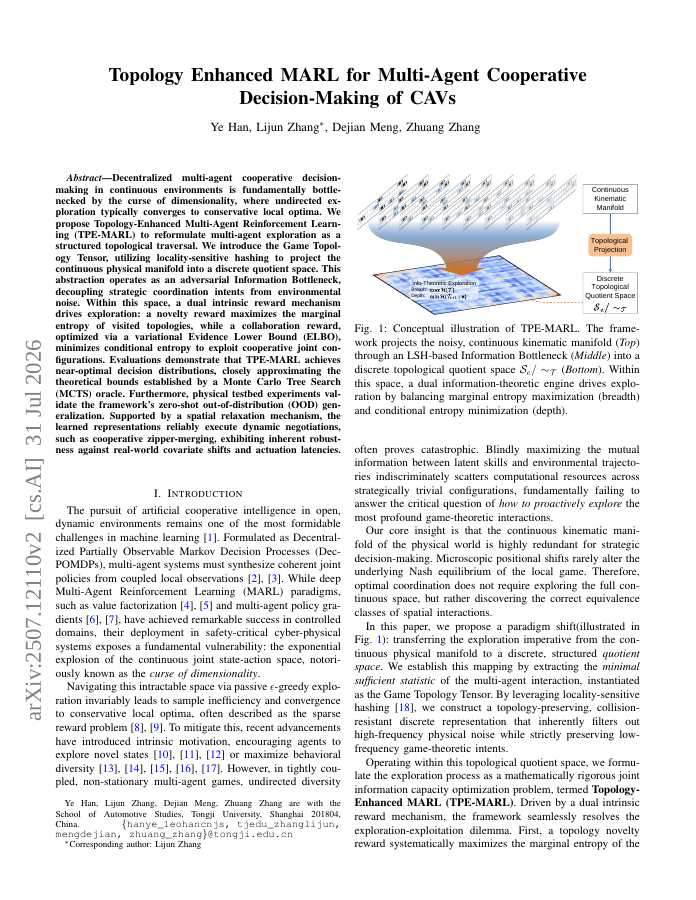
Decentralized multi-agent cooperative decision-making in continuous environments is fundamentally bottlenecked by the curse of dimensionality, where undirected exploration typically converges to conservative local optima. We propose Topology-Enhanced Multi-Agent Reinforcement Learning (TPE-MARL) to reformulate multi-agent exploration as a structured topological traversal. We introduce the Game Topology Tensor, utilizing locality-sensitive hashing to project the continuous physical manifold into a discrete quotient space. This abstraction operates as an adversarial Information Bottleneck, decoupling strategic coordination intents from environmental noise. Within this space, a dual intrinsic reward mechanism drives exploration: a novelty reward maximizes the marginal entropy of visited topologies, while a collaboration reward, optimized via a variational Evidence Lower Bound (ELBO), minimizes conditional entropy to exploit cooperative joint configurations. Evaluations demonstrate that TPE-MARL achieves near-optimal decision distributions, closely approximating the theoretical bounds established by a Monte Carlo Tree Search (MCTS) oracle. Furthermore, physical testbed experiments validate the framework's zero-shot out-of-distribution (OOD) generalization. Supported by a spatial relaxation mechanism, the learned representations reliably execute dynamic negotiations, such as cooperative zipper-merging, exhibiting inherent robustness against real-world covariate shifts and actuation latencies.
Topology Enhanced MARL for Multi-Agent Cooperative Decision-Making of CAVs
Decentralized multi-agent cooperative decision-making in continuous environments is fundamentally bottlenecked by the curse of dimensionality, where undirected exploration typically converges to conservative local optima.
- Preview
- Year
- 2025
- Hosting
- Abstract onlyARXIV-DEFAULT
Cite
Notes
Only stored in your browser.
Attribution
- Abstract & full text
- arxiv.org/abs/2507.12110ARXIV-DEFAULT
- TL;DR
- Semantic Scholar